|
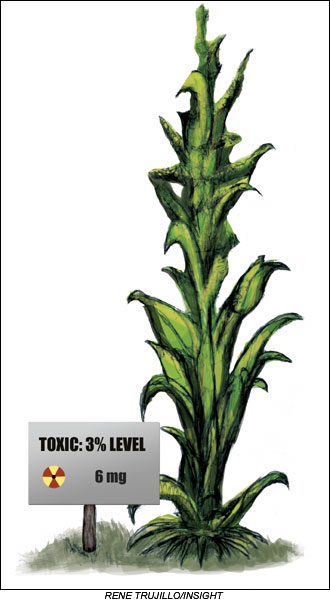
It is called "hormesis," and if this scientific theory is proved valid it
could be the most important environmental event of the 21st century. Billions of
dollars could be saved in environmental cleanup costs, say researchers, while at
the same time improving the health of all organisms, including humans. But at
first examination, hormesis appears kooky. The knee-jerk reaction is to reject
this phenomenon as pseudoscience or propaganda by polluters, and a few
uninformed observers have done just that.
But hormesis is a possible, if not highly probable, iconoclastic notion, first
postulated either in the 16th century or the 1880s but gaining flattering
attention within the last decade, that humans actually need small amounts of
poison in their diets. A little arsenic, dioxin or radiation peppered on the
spaghetti sauce may be just what we require to live long and healthy lives. And
since humans need more toxins in our environment than allowed under current
government regulations, so the theory goes, future efforts to clean up the
environment could be greatly reduced.
The idea is that poisons such as arsenic are, of course, poisonous - that is, if
one ingests too much they will produce sickness or death. But arsenic and other
toxins in very low doses, below an amount deemed harmful, repeatedly have been
shown to benefit the functions of organs, the optimal growth of the organism or
longevity. According to scientists who favor this theory, when the human body,
or cell, becomes stressed or damaged by a small amount of poison, it not only
repairs the damage but overcompensates and becomes stronger than it was. The
phenomenon is similar to exercise; by jogging or lifting weights, one may
stretch and exhaust the muscle tissue, which causes soreness. But later the
muscle not only repairs itself but overcompensates and improves to the point
where one can lift more weight or run longer and faster.
Chon Shoaf, a scientist with the Environmental Protection Agency (EPA) at
Research Triangle Park, N.C., says recent work on hormesis "is revolutionary and
we want people to be aware of it. It has the potential to generate substantial
savings."
The persons most responsible for conceptualizing and exalting this pioneering
research since the 1990s, and who may flip EPA policy upside down to the benefit
of taxpayers and every organism down to the last menacing insect, is Edward
Calabrese, 56, a toxicology professor at the University of Massachusetts at
Amherst, and his longtime assistant Linda Baldwin. He has been described as "one
of the leading toxicologists in the country." Speaking to Insight in his messy
office, whose floor for the last three years has featured what appears to be the
largest malfunctioning air conditioner ever seen on planet Earth, Calabrese
explains his breakthrough research. These are ideas, ironically, that were
generated not by an elite Massachusetts university with posh paraphernalia on
the banks of the Charles River, but rather from the "70 to 80 hours weekly" this
scientist toils at his lunch-pail university that the elitists sometimes refer
to as "Zoo Mass."
"I believe there is not a single chemical that does not" exhibit patterns of
hormesis, Calabrese says. It is a general response that is shown with mercury,
lead, components of cigarette smoke, cadmium, marijuana, cocaine, alcohol and
"everything that is regulated by the EPA."
One example is the first time Calabrese witnessed hormesis as an undergraduate
student at Bridgewater State College in Massachusetts in 1966. He had been
assigned to retard the growth of peppermint plants with high doses of a
growth-retardant chemical. Not only did the plants not die, they grew taller
than normal - a result, Calabrese says, that comes from mistakenly treating the
plants with what proved to be too little growth-retardant.
The policy implication for this work, if proved valid, is stratospheric. It
means the EPA could permit higher concentrations of so-called toxins in the
environment, actually encouraging healthier lives and simultaneously saving
money by not cleaning "toxic" sites. After all, the EPA now assumes the optimal
level for a vast majority of carcinogens is zero parts per billion - in other
words, none at all.
What makes the work of Calabrese and Baldwin especially credible as these things
go is that their research is not uniquely their own, but an analysis of
thousands of toxicology studies done by others the world over. "We evaluated
about 21,000 cases, using 2 percent on which the data were most complete,"
Calabrese says. "Of those 2 percent, 40 percent showed hormesis." Most
toxicology studies are not helpful in analyzing for hormesis because the doses
of toxins used are too high since researchers are studying a poison's threshold
of lethality and not its potential beneficial properties. According to
Calabrese, "The model showing hormesis has a huge amount of data, more than any
other competing model. This is so overwhelmingly convincing I do not think
anyone rational could deny that hormesis exists."
That said, another reason scientists are taking the work of Calabrese so
seriously is the environmental cleanup and expense implications of work he has
done in the past. At one point his studies drew the wrath of the chemical
industry, the same circle now delighting in his conclusions on hormesis. This
Massachusetts scientist was in fact the primary proponent of the
"single-exposure carcinogen theory," which says that humans sometimes can
contract cancer with just one exposure to a carcinogen, a theory with the
potential to add millions to the cost of chemical manufacturing. It also was
virtually his testimony alone in the 1990s that forced the government to spend
millions of additional dollars cleaning a toxic site in Colorado to a much
higher standard than previously expected, and contrary to the testimony of
others and at least one irate newspaper.
"I am nonideological," Calabrese says. "But my work on hormesis is a little like
President [Richard] Nixon going to China."
Calabrese is the first to say more research needs to be done "before we start
handing out radiation pills," though some researchers seem more cautious.
Nonetheless, this reporter was unable to find any toxicologist who substantially
disagreed with Calabrese's work on hormesis, including officials at the Sierra
Club, a prominent environmental advocacy group.
At the same time, "There are trade-offs in hormesis that we cannot forget
about," warns Michael Davis, an EPA scientist also in North Carolina. "I do not
believe all organisms share the same mechanical basis of hormesis. I see it as a
variety of things." Thus, each poison must be evaluated separately because each
particular toxin may affect different parts of an organism differently. For
example, a toxin at low doses may help a person grow taller, but also damage his
liver. Another difficulty is the possibility that a particular poison at a
certain dose may help one individual, yet hurt another, Davis says. "But I am
not ruling out that hormesis could have significant EPA policy implications."
According to Calabrese, hormesis also has an ugly side for some drugs prescribed
by physicians. It means some pharmaceuticals that might cure a sickness at high
doses could hurt at low doses. "The effects flip," he says. "So I want my doctor
to know about hormesis, though unfortunately most are unaware of it."
One who apparently did not know about hormesis, or at least whose office refused
to respond to repeated messages about it, was recently resigned EPA
administrator Christine Todd Whitman, who would not comment even on the work of
her own people on this matter.
"The EPA does not want the American people to become cognizant of good
environmental news, or potential savings in environmental cleanup, because in
part they view the agency as a jobs program," says a scientist who often engages
the EPA. "If the American people realize the environment is getting cleaner and
healthier, they might seek to cut the funding of the EPA because much of its
purpose has been accomplished. They seem to be afraid of losing their jobs."
Although properties of hormesis have been documented for many years, Calabrese
says there are several reasons why it took the scientific community so long to
examine hormesis and his research about it seriously. The EPA controls a large
part of the funding, and therefore how the research is conducted, he says. Since
the government is interested in saving lives, the research it funds in this area
is almost always to study a toxin's lethal effect, as opposed to its beneficial
side, so the research is not generated.
In addition, the beneficial effects of a poison tend to be less dramatic than
its deadly results, he says, so it is less noticeable. It may benefit a plant in
small amounts by only 30 percent, but in larger doses its pernicious effect may
be a factor of 10 times. Scientists also often will see a benefit of only 1
percent of the time in a study because most of the research involves much higher
doses, and "they blow it off," Calabrese says. "They think it is a freak thing.
They have to learn to think out[side] of the box."
But thanks in part to Calabrese and Baldwin, that box now has been broken wide
open and good news is spilling all over the ground. It is a toxic spill with
which we all can learn to live.
John Pike is a contributing writer to Insight magazine.
All comments generated by this article that I could find.
Theory of Hormesis Could Save Homeowners a Bundle
Thank you for John Pike's excellent article on hormesis ["Can
Toxins Lead to Healthier Lives?" Jan. 6-19]. I first became aware of this
theory in the context of the debate about radon. Insight's readers might like to
check out a number of articles about radon hormesis at the Doctors for Disaster
Preparedness Website (www.oism.org/ddp/lowdose.htm).
With the amount of money being mandated for radon remediation, new standards
based on a recognition of hormesis could save homeowners in my area a
considerable expense.
J. Keen Holland
Lenhartsville, Pa.
Dear Mr. Pike,
*
Your Recent article on hormesis was thought-provoking.* You may wish to follow up with the prof at U-Pittsburg who has advocated radiation hormesis for a number of years.* His radiation studies could save municipalities billions of dollars; many cities are being forced to reduce radiation content in drinking water.* But this same radiation content often attracted thousands to medicinal baths early in this century.
*
Hmmmm..
*
Best,
*
L A Stitch
============================
Forwarded to you by Citizens Demanding Scientific and Political Integrity
Quotes to ponder:
"People demand freedom of speech to make up for the freedom of thought which they avoid" Soren Kierkegaard (1813 - 1855)
"Only two things are infinite, the universe and human
stupidity, and I'm not sure about the former." Albert Einstein (1879 - 1955)
Yes, but how hard
did 'this reporter' try?
by not very hard, I suspect
• Friday January 09, 2004 at 11:25 AM
"Calabrese is the first to say more research needs to be done "before we start handing out radiation pills," though some researchers seem more cautious. Nonetheless, this reporter was unable to find any toxicologist who substantially disagreed with Calabrese's work on hormesis, including officials at the Sierra Club, a prominent environmental advocacy group."
I come to this subject with a bias--as a fan of "pseudoscience or propaganda by polluters"--so this (from Insight magazine, via WND) thrills me:
"According to the theory, a little arsenic, dioxin or radiation peppered on the spaghetti sauce may be just what we require to live long and healthy lives...
"The idea is that poisons such as arsenic are, of course, poisonous – that is, if one ingests too much they will produce sickness or death. But arsenic and other toxins in very low doses, below an amount deemed harmful, repeatedly have been shown to benefit the functions of organs, the optimal growth of the organism or longevity.
"According to scientists who favor this theory, when the human body, or cell, becomes stressed or damaged by a small amount of poison, it not only repairs the damage but overcompensates and becomes stronger than it was."
Wahoo! More poison, less EPA. Bring it on.
posted by eliana on 01.03.04 at 07:23 AM
Comments:
Just what are they teaching you guys over in New Haven, anyway? First Pat Roberson, then Bush, now the Diva ...
posted by:
Ron Mwangaguhunga on
01.03.04 at 11:50 AM [permalink]
I come to this subject with a bias--as a fan of "pseudoscience or propaganda by polluters"--so this (from Insight magazine, via WND) thrills me:
"According to the theory, a little arsenic, dioxin or radiation peppered on the spaghetti sauce may be just what we require to live long and healthy lives...
"The idea is that poisons such as arsenic are, of course, poisonous – that is, if one ingests too much they will produce sickness or death. But arsenic and other toxins in very low doses, below an amount deemed harmful, repeatedly have been shown to benefit the functions of organs, the optimal growth of the organism or longevity.
"According to scientists who favor this theory, when the human body, or cell, becomes stressed or damaged by a small amount of poison, it not only repairs the damage but overcompensates and becomes stronger than it was."
Wahoo! More poison, less EPA. Bring it on.
posted by eliana on 01.03.04 at 07:23 AM
Comments:
Just what are they teaching you guys over in New Haven, anyway? First Pat Roberson, then Bush, now the Diva ...
posted by:
Ron Mwangaguhunga on
01.03.04 at 11:50 AM [permalink]
Well, as I have been personnaly cured, fifteen years ago, with arsenic, I
can say that arsenic is not always a poison.
It is the same with many medecines your doctor give you : if taken in a high
dose they can kill you, if taken in an appropriate dose it can save you
life.
Radiations works the same way.
Jean-Claude
posted by: Oiseau
Jean-Claude on 01.16.04 at 09:11 AM [permalink]
what do you think of physicians when they prescribe low dosages of methotrexate for various diseases such as rheumatoid arthritis? this is a chemo drug given in low doses and physicians who write out the prescriptions. what do you think of that? i would like to think there might be a small bit of hope in the possiblity of hormesis. There is a place called Merry Widow Mine (article written in Nat'l Geographic) in Basin, Montana that claims they have people who come to there mine on a regular basis just for the healing effects. Could it be true or just another money maker? who knows
posted by:
lori on 01.27.04 at 09:59 PM [permalink]
News From
Babylon : Toxins lead to healthier lives?
... Propaganda by John Pike, WorldNet Daily
[US] January 3rd, 2004 'Revolutionary'
research suggests billions can be saved in cleanup costs Hormesis, the
...
www.newsfrombabylon.com/article.php?sid=3588 - 41k -
Cached -
Similar pages
News From Babylon : NFB Homepage
... Propaganda by John Pike, WorldNet Daily [US] January 3rd, 2003 'Revolutionary'
research suggests billions can be saved in cleanup costs Hormesis, the ...
www.newsfrombabylon.com/index.php - 101k - Cached - Similar pages
|
http://www.worldnetdaily.com/news/article.asp?ARTICLE_ID=36421 Note: Scientists begin measuring pollution in human bodies |
|


|
http://www.worldnetdaily.com/news/article.asp?ARTICLE_ID=36421 Note: Scientists begin measuring pollution in human bodies |
User Comments Begin Here
|
For your daily dose of debunking, from Steve Milloy,
visit the Junk Science Home Page.
Special rules for this forum.

|
 Debunkers Debunkers
 Demon
Tobacco Demon
Tobacco  Hormesis:
Can Toxins Lead to Healthier Lives? Hormesis:
Can Toxins Lead to Healthier Lives?
|
 UBBFriend: Email This Page to Someone!
 |
next newest topic | next oldest topic |
| Author | Topic: Hormesis: Can Toxins Lead to Healthier Lives? |
|
lockjaw02 Member |
 posted 01-03-2004 10:57
PM
posted 01-03-2004 10:57
PM


Edward Calabrese, 56, a toxicology professor at the University of Massachusetts at Amherst, is apparently a reformed believer in hormesis. According to this article Calabrese was the guy who costs industry millions in environmental cleanup expenses from his previous work and was the primary proponent of the "single-exposure carcinogen theory".
Wonder what this will do to
environmental tobacco smoke theories. IP: Logged |
|
lockjaw02 Member |
posted 01-15-2004 08:04
PM
Since this topic generated so much interest, figured you might like to see the full text, Hormesis as a Biological Hypothesis, at nih.gov. IP: Logged |
| GLP Member |
posted 01-16-2004 05:59
AM
Not read the article fully yet but I was suddenly reminded of experiences with anti-ant products. The powders seem to work OK of spread around but only prevent not 'cure'. The 'get them to to take the poison back to the nest and kill the others' approach seems to fail woefully. All the times I persevered with that approach just resulted in more and more ants. Maybe the manufacturer's instruction to use just a few drops was more for marketing benefit (repeat sales potential) than for true purpose. Perhaps I should have used several gallons rather than a few drops? Grant IP: Logged |
| entropy Member |
posted 01-16-2004 01:14
PM
Calabrese has also published on radiation hormesis. I had some discussions with Petr Beckmann on this subject during the 80's and early 90's, prior to his death. Have also attended presentations at DDP meetings. Googling today gets 2380 hits for radiation hormesis but only 488 for chemical hormesis. There are also a few hormesis posts in our archives. My interest in this subject has to do with having had considerable radiation exposure over the years, as a child and occupationally. IP: Logged |
| All times are ET (US) | next newest topic | next oldest topic |
Administrative Options: Close Topic | Archive/Move | Delete Topic |
|
  |
|
Copyright Restrictions: You should know the drill by now. If you post it here, then you promise that you have the right to do so and pledge to defend and hold harmless this board and the staff which manages daily operations.
The staff reserves the right to edit or delete material you submit if, in its judgment, your claim is not reasonable.
Powered by Infopop
www.infopop.com ©
2000
Ultimate Bulletin Board 5.45c
[Date Prev][Date Next] [Chronological] [Thread] [Archive Top]
[cdn-nucl-l] Hormesis and Ed Calabrese positively reported by John Pike
- To: <mbrexchange@list.ans.org>, <cdn-nucl-l@informer2.cis.mcmaster.ca>
- Subject: [cdn-nucl-l] Hormesis and Ed Calabrese positively reported by John Pike
- From: Muckerheide <muckerheide@comcast.net>
- Date: Thu, 01 Jan 2004 04:45:06 -0500
- In-reply-to: <008f01c3cd47$0d6c9da0$6400a8c0@wlfdle.phub.net.cable.rogers.co>
- List-archive: <http://mailman.McMaster.CA/mailman/private/cdn-nucl-l/>
- List-help: <mailto:cdn-nucl-l-request@mailman.McMaster.CA?subject=help>
- List-id: Canadian Nuclear Discussion List <cdn-nucl-l.mailman.McMaster.CA>
- List-post: <mailto:cdn-nucl-l@mailman.McMaster.CA>
- List-subscribe: <http://mailman.McMaster.CA/mailman/listinfo/cdn-nucl-l>,<mailto:cdn-nucl-l-request@mailman.McMaster.CA?subject=subscribe>
- List-unsubscribe: <http://mailman.McMaster.CA/mailman/listinfo/cdn-nucl-l>,<mailto:cdn-nucl-l-request@mailman.McMaster.CA?subject=unsubscribe>
- User-agent: Microsoft-Entourage/10.0.0.1309
Friends,

Ed Calabrese's work is very positively reported, disparaging persons
who question the effects, by Dr. John Pike. Dr. Pike has a very high
profile and is a widely quoted spokesperson on science, especially space
and security. He was a national spokesman for 20 years with the
Federation of American Scientists.

Please forward this to your science and industry associates, to your
contacts in policy and media, and to family and friends, preferably with
your own comments and support to continuing the effort to document the
science.  (And to disparage the naysayers? :-)

Thank you. And have a Happy New Year!
Regards, Jim Muckerheide
========================
FreeRepublic.com "A Conservative News Forum"
Click to scroll to commentary.
Toxins lead to healthier lives?
WorldNetDaily.com ^ | Saturday, January 3, 2003 | John Pike
Posted on 01/03/2004 6:43:01 AM PST by
JohnHuang2
By John Pike
© 2004 Insight/News World Communications Inc.
Hormesis, the scientific theory that humans actually need small amounts of poison in their diets, could be the most important environmental event of the 21st century if proved valid. Billions of dollars could be saved in environmental cleanup costs, say researchers, while at the same time improving the health of all organisms, including humans.
But at first examination, hormesis appears kooky. The knee-jerk reaction is to reject this phenomenon as pseudoscience or propaganda by polluters, and a few uninformed observers have done just that.
But hormesis is a possible, if not highly probable, iconoclastic notion, first postulated either in the 16th century or the 1880s but gaining flattering attention within the last decade.
According to the theory, a little arsenic, dioxin or radiation peppered on the spaghetti sauce may be just what we require to live long and healthy lives. And since humans need more toxins in our environment than allowed under current government regulations, so the theory goes, future efforts to clean up the environment could be greatly reduced.
The idea is that poisons such as arsenic are, of course, poisonous – that is, if one ingests too much they will produce sickness or death. But arsenic and other toxins in very low doses, below an amount deemed harmful, repeatedly have been shown to benefit the functions of organs, the optimal growth of the organism or longevity.
According to scientists who favor this theory, when the human body, or cell, becomes stressed or damaged by a small amount of poison, it not only repairs the damage but overcompensates and becomes stronger than it was. The phenomenon is similar to exercise; by jogging or lifting weights, one may stretch and exhaust the muscle tissue, which causes soreness. But later the muscle not only repairs itself but overcompensates and improves to the point where one can lift more weight or run longer and faster.
Chon Shoaf, a scientist with the Environmental Protection Agency, or EPA, at Research Triangle Park, N.C., says recent work on hormesis "is revolutionary and we want people to be aware of it. It has the potential to generate substantial savings."
The persons most responsible for conceptualizing and exalting this pioneering research since the 1990s, and who may flip EPA policy upside down to the benefit of taxpayers and every organism down to the last menacing insect, is Edward Calabrese, 56, a toxicology professor at the University of Massachusetts at Amherst, and his longtime assistant Linda Baldwin. He has been described as "one of the leading toxicologists in the country." Speaking to Insight in his messy office, whose floor for the last three years has featured what appears to be the largest malfunctioning air conditioner ever seen on planet Earth, Calabrese explains his breakthrough research. These are ideas, ironically, that were generated not by an elite Massachusetts university with posh paraphernalia on the banks of the Charles River, but rather from the "70 to 80 hours weekly" this scientist toils at his lunch-pail university that the elitists sometimes refer to as "Zoo Mass."
"I believe there is not a single chemical that does not" exhibit patterns of hormesis, Calabrese says. It is a general response that is shown with mercury, lead, components of cigarette smoke, cadmium, marijuana, cocaine, alcohol and "everything that is regulated by the EPA."
One example is the first time Calabrese witnessed hormesis as an undergraduate student at Bridgewater State College in Massachusetts in 1966. He had been assigned to retard the growth of peppermint plants with high doses of a growth-retardant chemical. Not only did the plants not die, they grew taller than normal – a result, Calabrese says, that comes from mistakenly treating the plants with what proved to be too little growth-retardant.
The policy implication for this work, if proved valid, is stratospheric. It means the EPA could permit higher concentrations of so-called toxins in the environment, actually encouraging healthier lives and simultaneously saving money by not cleaning "toxic" sites. After all, the EPA now assumes the optimal level for a vast majority of carcinogens is zero parts per billion – in other words, none at all.
What makes the work of Calabrese and Baldwin especially credible as these things go is that their research is not uniquely their own, but an analysis of thousands of toxicology studies done by others the world over.
"We evaluated about 21,000 cases, using 2 percent on which the data were most complete," Calabrese says. "Of those 2 percent, 40 percent showed hormesis." Most toxicology studies are not helpful in analyzing for hormesis because the doses of toxins used are too high since researchers are studying a poison's threshold of lethality and not its potential beneficial properties. According to Calabrese, "The model showing hormesis has a huge amount of data, more than any other competing model. This is so overwhelmingly convincing I do not think anyone rational could deny that hormesis exists."
That said, another reason scientists are taking the work of Calabrese so seriously is the environmental cleanup and expense implications of work he has done in the past. At one point his studies drew the wrath of the chemical industry, the same circle now delighting in his conclusions on hormesis.
This Massachusetts scientist was in fact the primary proponent of the "single-exposure carcinogen theory," which says that humans sometimes can contract cancer with just one exposure to a carcinogen, a theory with the potential to add millions to the cost of chemical manufacturing.
It also was virtually his testimony alone in the 1990s that forced the government to spend millions of additional dollars cleaning a toxic site in Colorado to a much higher standard than previously expected, and contrary to the testimony of others and at least one irate newspaper.
"I am nonideological," Calabrese says. "But my work on hormesis is a little like President [Richard] Nixon going to China."
Calabrese is the first to say more research needs to be done "before we start handing out radiation pills," though some researchers seem more cautious. Nonetheless, this reporter was unable to find any toxicologist who substantially disagreed with Calabrese's work on hormesis, including officials at the Sierra Club, a prominent environmental advocacy group.
At the same time, "There are trade-offs in hormesis that we cannot forget about," warns Michael Davis, an EPA scientist also in North Carolina. "I do not believe all organisms share the same mechanical basis of hormesis. I see it as a variety of things." Thus, each poison must be evaluated separately because each particular toxin may affect different parts of an organism differently.
For example, a toxin at low doses may help a person grow taller, but also damage his liver. Another difficulty is the possibility that a particular poison at a certain dose may help one individual, yet hurt another.
"But I am not ruling out that hormesis could have significant EPA policy implications," says Davis.
According to Calabrese, hormesis also has an ugly side for some drugs prescribed by physicians. It means some pharmaceuticals that might cure a sickness at high doses could hurt at low doses. "The effects flip," he says. "So I want my doctor to know about hormesis, though unfortunately most are unaware of it."
One who apparently did not know about hormesis, or at least whose office refused to respond to repeated messages about it, was recently resigned EPA administrator Christine Todd Whitman, who would not comment even on the work of her own people on this matter.
"The EPA does not want the American people to become cognizant of good environmental news, or potential savings in environmental cleanup, because in part they view the agency as a jobs program," says a scientist who often engages the EPA. "If the American people realize the environment is getting cleaner and healthier, they might seek to cut the funding of the EPA because much of its purpose has been accomplished. They seem to be afraid of losing their jobs."
Although properties of hormesis have been documented for many years, Calabrese says there are several reasons why it took the scientific community so long to examine hormesis and his research about it seriously. The EPA controls a large part of the funding, and therefore how the research is conducted, he says. Since the government is interested in saving lives, the research it funds in this area is almost always to study a toxin's lethal effect, as opposed to its beneficial side, so the research is not generated.
In addition, the beneficial effects of a poison tend to be less dramatic than its deadly results, he says, so it is less noticeable. It may benefit a plant in small amounts by only 30 percent, but in larger doses its pernicious effect may be a factor of 10 times. Scientists also often will see a benefit of only 1 percent of the time in a study because most of the research involves much higher doses, and "they blow it off," according to Calabrese.
"They think it is a freak thing. They have to learn to think out[side] of the box," he says.
But thanks in part to Calabrese and Baldwin, that box now has been broken wide open and good news is spilling all over the ground. It is a toxic spill with which we all can learn to live.
TOPICS:
Front Page News;
News/Current Events
KEYWORDS:
ENVIRONMENT;
EPA;
HEALTH;
HORMESIS;
JOHNPIKE;
POISON;
TOXINS
Navigation: use the links below to view more comments.
first
1-50, 51-91
next
last
| Rank | Location | Receipts | Donors/Avg | Freepers/Avg | Monthlies | |||
|---|---|---|---|---|---|---|---|---|
| 28 | Idaho | 60.00 |
2 |
30.00 |
92 |
0.65 |
45.00 |
2 |
Thanks for donating to Free Republic!
Move your locale up the leaderboard!
C2H5OH
Well, DUH!!!
The EPA IS nothing more than a government bureaucracy.
All bureaucracies are metastasized cancers whose sole purpose is to consume
resources and grow larger.
I have consumed huge amounts of asbestos, lead (siphoning gas, chewing it for gum, breathing lead oxide and paint, sanding body lead before bondo, etc.), trichlorethlene, and the vapors from spraying around 1000 gal. of paint yearly, dust from construction and anything else you might think of including DDT which I love the smell of and i've smoked since I was 11.
It's now been 57 years since i've been sick, had the measles when I was 8, and have never had the flu.
It seems we're not the only ones who have been saying the same thing for
quite some time!!!
It's just possible
it could keep you healthier.
Sorry for the bad grammar in the prior post.
We tried every imaginable form of therapy, from cortisone injections to nutrition to acupuncture. Nothing worked, at all, and some of the side effects were nasty.
We finally located a homeopath 4 hours away. We drove there, went through the whole interview process, and he gave her a tiny amount of sulphur. At this point, she hadn't really slept in two days and nights. Within about 30 seconds of the sulphur entering her mouth, she went right to sleep. She slept all the way home and for almost 24 hours straight. When she woke up her eczema was almost entirely gone, and with one relapse has never come back.
This was over 20 years ago, when homeopathy was almost an underground movement.
I can't explain these results by standard science. The classic AMA
explanation for the successes of homeopathy is "placebo effect." I defy anyone
to get placebo effect to work on a 2-year old!
Oh, and she is a
strict vegetarian who has thyroid, glaucoma, high cholesterol and heart
problems.
Just like the Sugeon General. He is neither a Surgeon OR a General. heh!

I went out to eat with someone last night.
I ordered the Tuna sandwhich. They then told me that it was best "not to eat that" because there is a risk that the Tuna might be bad.
And this wasn't at some 2 bit restuarant either!
Oh yes! They sure know how to spin it. They don't want to tell the truth for fear of losing their jobs and/or funding. Just like the Anti-Tobacco Coalitions.
You got it, Gabz!
What a total waste of tax payers money!
OH MY GAWD HE SMOKES! THROW HIM INTO A HOLDING CELL!
My goodness! It IS legal you know. heh!
I've heard it called "lazy lung" in that the lungs never breathe anything even slightly toxic and therefore can't fight off lung disease.
I've heard it called "lazy lung" in that the lungs never breathe anything even slightly toxic and therefore can't fight off lung disease.
Larger issue here is, of course: women. (Dons flame-retardant material). Ever since they got uppity with this women's lib crap (not to mention getting the vote), they do what women do: worry and fret and try to keep their kids safe from anything and everything. I mean, it's a natural instinct, there is no faulting that. The fault is the excesses this has been carried to through overempowerment. Oh, and certain geldings like Ralph Nader.
Kids are gonna get sick, skin their knees, break an arm climbing a tree, run through poison oak. That's what they do. That's what they HAVE to do, and aren't being allowed to do by a combination of government regulation, state education, and a de-balled society in general.
There's a whole Taoist discussion that could be brought in here, but
basically, it can be summed as: we've lost our natural balance. If it's not
regained one way, nature has a way of correcting us in another.
Kids need to explore and experiment,fight with eachother,and yes,get hurt,or how are they going to get along in the larger world.
I live in a city with neighborhood elementary schools so that kids can walk,but that's not done anymore. The mothers are there with the SUVs waiting every day,and the kids never walk to or from school.
Kids need to roll in the dirt more,forget these scheduled "play dates",and learn to get along without adult supervision.
Guess what?
Her kids (and she) are sick ALL THE TIME. They have spent the entire winter fighting coughs, colds, flus, and other assorted viruses. But they CAN'T fight them (especially the kids), because she hasn't allowed their little immune systems to GROW. The instant the children get even the teeniest bit dirty (like when playing with MY kids, for example), she rushes them off to the anti-bacterial soap factory that is her bathroom.
She is shocked (SHOCKED, I tell you!) to find that I do not own one single bar of the nasty orange stuff (Ivory for us, thanks).
Now, while my house isn't dirty, I confess to not being the "I've got to dust, vacuum and sterilize this place every day" type. Having a sterile house is fine if you never plan to go OUT, but unless you are a hermit, you will go out and get exposed to all kinds of nasty little bugs. With no natural immune system upon which to rely, you may as well be wearing a great big bulls-eye for the germs on your back.
As far as I'm concerned, the best way to keep everybody healthy is to OPEN THE DOORS or CRACK THE WINDOWS to let fresh air in.
Sis-in-law insists on an hermetically-sealed house. It's clean, but it smells like a dentist's office...
Regards,
I was brought up in the 50's and 60's. ALL THE ADULTS SMOKED! I worked in a nightclub, where everyone smoked. Other jobs I had.........everyone smoked. Going out to nightclubs at night with friends, drinking and smoking and NO smoke eaters!
I could go on and on but you already know what I am going to say.............there was NO ASTHMA back in those days. NONE. And kids weren't so sickly either.
The anti's today would have everyone believe that asthma and all the ill health of kids are blamed on smoking. But I don't think there are many today that smoke around their kids, do you? The Health Department has embedded guilt in responsible adults so deep that they don't DARE smoke around their kids.
I'm sick of this War on the Smokers and I sure am sick of TRUTH and all the
Partnership for a Tobacco Free Coalition across the U.S. (I need a cigarette
to calm down...........)
Let me know if you wish to be added or
removed from this list.
I don't get offended if you want to be removed.
The vet that I use for my dog even has a sign on the wall saying that smoking is bad for pets.Try to explain that to my 12 year old Sheltie who was preceded by another Sheltie who lasted 15 years.(Of course they were both non- smokers so the antis would say that's why they lived so long)
I've said it before,we are living in a world gone mad with junk science.
Source: OSHA
http://www.osha-slc.gov/FedReg_osha_data/FED19940405.html
A wide variety of substances are emitted by building construction materials
and interior furnishings, appliances, office equipment, and supplies, human
activities, and biological agents.
For example, formaldehyde is emitted from various wood products, including
particle board, plywood, pressed-wood, paneling, some carpeting and backing,
some furniture and dyed materials, urea-formaldehyde insulating foam, some
cleaners and deodorizers, and from press textiles. Volatile organic compounds,
including alkanes, aromatic hydrocarbons, esters, alcohols, aldehydes, and
ketones are emitted from solvents and cleaning compounds, paints, glues,
caulks, and resins, spray propellants, fabric softeners and deodorizers,
unvented combustion sources, dry-cleaning fluids, arts and crafts, some
fabrics and furnishings,
stored gasoline, cooking, building and roofing materials, waxes and polishing
compounds, pens and markers, binders and plasticizers. Pesticides also contain
a variety of toxic organic compounds.
Building materials are point sources of emissions that include a variety of
VOCs (Table
III-1).
Some of these materials have been linked to indoor air quality problems.
The probability of a source emitting contaminants is related to the age of the
material. The newer the material, the higher the potential for emitting
contaminants. These materials include adhesives, carpeting, caulks, glazing
compounds, and paints [Ex. 4-33]. These materials, as well as
furnishings can act as a sponge or sink in which VOCs are absorbed and then
re-emitted later.
Appliances, office equipment, and supplies can emit VOCs and also
particulates [Ex.
4-33]. Table III-2 lists the many contaminants that can be emitted from these
point sources.
There is an indirect relationship between the age of the point source and the
potential rate of
contaminant emission [Ex. 4-33].

It goes on to list all the "evils" in our home.
And many of these toxins are in buildings where you can't even open a window and have to breathe re-circulated air all day.
THe antis never look at those facts,though,it might dilute their agenda.
Oh yes! The Coalition of PAID Anti's have gotten to the medical society, that's for sure.
I always have pets in my home. Mostly cats. But they ALL live well past 14 years old. And they are indoor cats. In the summer, I might take them in the yard on a leash, but not that much. They are completely indoor pets. None of them wheeze and cough and have watery eyes, not ever.
What does THAT tell you?
And before Ralph died recently, there was always at least two smokers in this house. My daughter smokes, and SHE smoked in this house before she got married. So, that was THREE smokers in this house. Never bothered our beloved pets one bit.
Just another saga for the War On The Smokers.
What a way to live! She will drive herself and her kids crazy if she doesn't lighten up.
Too much use of anti bacterials are proving to be harmful.
Here's another thing I will tell you: I was a Travel Agent when Northwest, in all their glory, was the first airline to go smoke free and proud of it. That opened the door to the rest of the airlines being forced into going smoke free............now the AIRPORTS are smoke free.
Well, Northwest said that their FILTERS in the PLANES were FILTHY from the smoke. After a few years, one brave soul came forward and said that THEY ARE STILL FILTHY! That re-circulated air is just full of pollutants.
Why? Because when the airlines went smoke free, they thought they didn't
have to change the filters as much. Heh! And people are breathing in that
foul, bacteria laden air, and all the non-smokers think that the air in planes
are just fine, because gee whiz................NO ONE IS SMOKING. Wake UP
people! SARS ANYONE?
Excerpt:
Offices can make you sick, according to the British Allergy Foundation.
A survey by NOP found at least 40% of office workers have symptoms which have been linked to sick building syndrome, such as sore eyes and throats, headaches and tiredness.
Many workers would put those symptoms down to the stress of poring over a complex report.
As a result people are more like to get diseases. Talk about throwing out the baby with the bathwater. I'd rather put up with a smokey atmosphere than contract TB,than you very much.
My daughter and son-in-law smoke. But since they had the baby, they go outside on their balcony to smoke. They have three cats. The one cat always had watery eyes. And it hasn't let up the past two years since they have been smoking on the balcony. I dunno............I guess there is an argument to everything.

"THEY" say that smoking is the root of
ALL evils. Well, I think people are finding out that this just isn't true.
You Don't Smoke? Guess You're Safe? Think Again. And Then Stop Wasting Your Life Worrying.
Also... You think someone else's cigarette
smoke is killing you? Check out what the real threats are.
THE WORLD HAS BEEN CHEATED BY THE ANTI-TOBACCO CARTEL
USA Federal Court Judge Osteens Rulings
THE DAMNING DECISION
Here is the whole US Federal Court decision. This decision makes liars of all those "professionals" who have exposed themselves by stating that ETS hurts children and adults. It severely questions the integrity of our institutions, and those ministries and department of health who have promoted smoking bans, and manipulated the public opinion into the perception that "smokers are killers". It accuses politicians, health activists, certain doctors, and whoever else has engaged in the persecution of smokers of being corrupted. The anti-smoking cartel has been officially stamped with the truth. But this will not deter it from proceeding with its agenda of repression and deceit. In fact, the cartel has already announced that this decision will not alter its agenda.
When exposed for what it is, the cartel shows no modesty, but it even accelerates the suppression of liberties and its criminal promotion of deceit for as long as it is not stopped by the force of those who are the oppressed.
THE TEXT OF THE DECISION OF THE US FEDERAL COURT ON THE CONCLUSIONS OF THE EPA
"EPA publicly committed to a conclusion before research has begun; excluded industry by violating the [Radon] Act's procedural requirements; adjusted established procedure and scientific norms to validate the agencies public conclusion, and aggressively used the Act's authority to disseminate findings to establish a de facto regulatory scheme intended to restrict Plaintiff's products and to influence public opinion" "The Court is faced with the ugly possibility that EPA adopted a methodology for each chapter, without explanation, based on the outcome sought in that chapter"
"The Court is disturbed that EPA and Kenneth Brown [one of the EPA report's authors] buttress the bioplausibility theory with epidemiological studies. EPA's theory must be independently plausible"
JUDGE OSTEEN'S ORDER
Judge Osteen granted Plaintiff's (the tobacco industry's) motion for partial summary judgement, ordering that Chapter 1 to Chapter 6 and appendices in the EPA's "Respiratory Health Effects of Passive Smoking: Lung Cancer and Other Disorders," (December 1992), be vacated. According to Black's Law, Fourth Edition, the term "vacated" means:
To annul; to set aside; to cancel or rescind; to render an act void; as, to vacate an entry or record, or a judgement.
In layman's terms, Chapters 1 to 6 and appendices to that 1992 EPA secondhand smoke report no longer exist. Therefore, the following conclusions, as taken verbatim from Chapter 1, page 1, of the report, do not exist, and must be disregarded:
THE EPA STATED:
("1.1 Major Conclusions:") THE US FEDERAL COURT RULED:
"Based on the weight of the available scientific evidence, the U.S.
Environmental Protection Agency (EPA) has concluded that the widespread
exposure to environmental tobacco smoke (ETS) presents a serious and
substantial public health impact." VACATED
In adults: "ETS is a human lung carcinogen responsible for approximately 3,000 lung cancer deaths annually in the U.S. nonsmokers." VACATED
In children: "ETS exposure is casually associated with an increased risk of lower respiratory tract infections LRIs) such as bronchitis and pneumonia. This report estimates that 150,000 to 300,000 cases annually in infants and young children up to 18 months of age are attributed to ETS." VACATED
"ETS exposure in casually associated with increased prevalence of fluid in the middle ear, symptoms of upper respiratory tract irritation, and small but significant reduction in lung function." VACATED
"ETS exposure is casually associated with additional episodes and increased severity of symptoms in children with asthma. This report estimates that 200,000 to 1,000,000 asthmatic children have their condition worsened by exposure to ETS." VACATED
"ETS exposure is a risk factor for new cases of asthma in children who have not previously displayed symptoms." VACATED
################################
USA Federal Court Judge Osteen's Decision. The EPA ETS Fraud. (1998)
The full 93-page decision document is a synopsis of that decision. This judge vacated all the EPA scientific findings on ETS as fraud and lies and states that passive smoking is not a carcinogen. Vacated means that the science involved no longer exists. The antis are still using this unavailable struck down bullshit against the smoker and the media lets them. WHY???
The decision accuses politicians, health Nazis, certain doctors, and whoever else has engaged in the persecution of smokers of being corrupt. In other words this learned and respected judge is informing you dumbass reporters that anti-smokers lie their bloody pants off, but is this newsworthy, hell no, you lot just keep taking the crap off the antis with no investigation into its being factual and print it. Are you a bunch of spineless jellyfish? Why are you frightened to go against the health Nazis? If I as a factory worker can see through the crap why cant you??
I need say no more about this decision it speaks volumes for itself, take the time to find the full court transcript and ask yourself why this was not the biggest news story of the 20th century. ANTI-SMOKING CARTELS AND HEALTH ACTIVIST, GOVERNMENT LIED. The general public and even the smoker have been lied to and brainwashed on this subject through the media for so long now that they believe anything they hear because they never or rarely hear anything pro-smoking. Like the juror on the latest 173billion dollar lawsuit in the state believed that a smoker couldn't get throat cancer any other way but from his smoking, his work didn't matter and now anything the tobacco industry says is seen as a lie without any research into the matter. If you smoke by association that is what you die of. It's a lie a damned lie and there are many scientists and doctors who would back me up on that.
And the anti-smoking lies go on as they still try to tell whoever is silly enough to listen that Judge Osteen did not deal with asthma and ETS. Bloody lying bastards!!!!!
Joy Faulkner
Navigation: use the links below to view more comments.
first
1-50, 51-91
next
last
Disclaimer: Opinions posted on Free Republic are those of the individual posters and do not necessarily represent the opinion of Free Republic or its management. All materials posted herein are protected by copyright law and the exemption for fair use of copyrighted works.
FreeRepublic.com "A Conservative News Forum"
Click to scroll to commentary.
Toxins lead to healthier lives?
WorldNetDaily.com ^ | Saturday, January 3, 2003 | John Pike
Posted on 01/03/2004 6:43:01 AM PST by
JohnHuang2
Navigation: use the links below to view more comments.
first
previous
1-50, 51-91
last
Who knew?
I kept an article from our local newspaper, May 31, 2003, entitled "Want healthy children? Let 'em eat a little dirt." It's hypothesis is that "early childhood exposure to dirty conditions, including bacteria and other disease-causing germs is important for normal development of the immune system."
Speaking for myself and my family, I think there's some validity to this theory. I remember one day when my daughter (then 2) picked up and ate a rolly-polly bug while playing in the front yard! That happened only once, and of course we discouraged her from repeating the "game." Both of my children are now college freshmen and have seldom been sick. (She has more problems with monthly cramps than with any illness.)
Conversely, those peers of my children who received drugs and/or doctor-visits for every minor cold, cut or problem seem to have developed more allergies and/or tendancy toward illness as adults.
I believe there's something to be said for this theory that exposure to
"dirty conditions, including bacteria" during childhood does go a long way
toward building up the immune system of that person in adulthood!
Will they ever stop????
Not for awhile, they won't. Not until smokers
wise up and stop their funding.
We ARE all different. I am not arguing with you.
What's good for me isn't good for you and what's good for you isn't good for me.
I'm sorry about your health. Is there anything you can do?
What am I allergic to? Heat?
go
HERE and read a short article about "homegrown vaccines."
I thought I read somewhere
that they are beginning to realize that all these germicides being overused so
constantly is becoming a problem, and people are being sensitized to the
chemicals used to kill the bacteria.
*chuckle* I read this as you smoked DDT since age 11. I was impressed. ;-)
I worked with a young fellow who was always sick, and was rather obsessed with germs and what not. Turns out he was constantly on prescription drugs like penecillin. He was diagnosed with a full-body yeast infection.
My son was constantly sick as a baby, and the doctor kept prescribing
amoxycillin for anything and everything he said he had. I pressured my wife to
switch doctors and not take the kid in every time he sniffled. After going
through a bout of something without medical assistance the kid never got sick
as frequently again.
You and I are in the same boat, except I heat with wood in a big wood furnace in the basement with an oil furnace for back-up. I, too, sneeze at times. I used to have a humidifier but ran out of room for it.
That seemed to help. I also keep the filters in both furnace changed often. They get really filthy. Especially the wood furnace one.
I think it's because we are inside a closed house and the dry heat the furnaces put out plays hell with our sinuses. It's horrible, I know. I am just now getting over a terrible sinus infection.
And if anyone has ever had one of those, they know the pain and misery they cause.
I never had sinus problems until we moved into this house and started
heating with oil and wood. Before we moved to Maine, we had central heating.
EVERYWHERE. oh well.
I've even snorted water for some relief!
Then, in the summer, with the windows open, I am breathing in the
clouds of pesticide that the farmers put on the fields. I have three fields
around my house. Wonder how I am still alive. hehe!
The seat belt law drives me insane, I went to jail for 24 hrs. instead of paying the fine which the judge reducted it from 108.00 to 15.00, I still wouldn't pay. If everyone did that instead of just mailing a check in and tied up the court system, that little law wouldn't last long either.
No one is willing to fight anymore, they keep chinking away at our freedoms on a day to day basis, all in the name of safety and concern. WAKE UP AMERICA before its to late.
No...you need more moisture in the air. Summers are more humid and keep your nose from drying and cracking inside, go buy a humidifier or when its really hurting, put a pan of water on the stove, bring it to a boil, throw a towel over your head with the pan and breath the steam. It will make it feel better. I'm sure your nose looks like the cracked desert on the inside....lol.
Let me guess...now she has teeth and gum problems and poops mortar mix......roflmao.
It's only been the last 150 or so years that there has even been a germ theory of disease - before then, cleanliness was an aesthetic (or in some cases ritualistic) mattter.
Also, if things like eating dirt were *really* bad, they'd have been selected out a long time ago.
I'm surprised no-ones quoted Nietzsche:
That which does not kill us, makes us stronger.
I was always miserable with the forced air heat we had in Delaware, I always kept a window open and pans of water on top of the floor vents for some moisture. And that was natural gas.
Now we have the opposite problem. We have an oil fired furnace but it fuels a baseboard hot water heating system. There is too much moisture in the house so we wound up with mold and all of us were sick for more than a month before we found and eradicated the major source of the mold. We are also firing up the wood stove a little more often in order to dry things out.
My husband and I spent the 3 days after Christmas smelling like clorox and lysol but by Monday we all felt better than we had since before Thanksgiving. And yesterday he spent the day pulling up the old vinyl tiles from the bathroom floor. We've got an electric space heater going in there right now trying to get the sub floor fully dried so that we can put in ceramic tile.
I'm clean - but I'm not a fanatic such as an earlier post described an SIL. One of my daughter's favorite past times is creating mud puddles and making mud pies!!!! She is rarely sick, and even when she does get sick, she's over it within a day or two.
I'm glad you solved your mold problem.
You know, it might be worth it for me to move to a place that had hot water heating - it beats having your nose hurt five months a year. Any other drawbacks (besides the mold)?
Where we live there is a very high humidity factor and we've had a horrendous amount of rain since September, nothing is drying and the ground is thoroughly saturated.
There was a tremendous amount of mold build up on the outside of the house and my husband went through 4 gallons of bleach getting rid of it. It actually looks like he put a new coat of paint on it. So between the exterior mold, the high humidity, all the rain, the dampness under the vinyl tile in the bathroom and the hot water heating system - we had a major problem.
Actually there is one drawback to this type of heating system - you most likely would have to buy a much older house or have one custom built. Our house was built in 1945 but the heating system was installed later - it's an old farmhouse that used to beheated with a woodstove. I think the baseboard hot water systems became popular in the early 60s.
"Has he asked for anything special?"
"For breakfast, he requested something called wheat germ, organic honey, and tiger's milk."
"Ahh, yes, yes, back then people thought of such things as charmed substances that contained life-preserving properties."
"You mean there was no deep fat, no steak, or hot fudge?"
"Oh, no, those were thought to be unhealthy, precisely the opposite of what we now know to be true."
"Incredible!"
......................................
Later, Miles/Woody watches Diane Keaton's character light up a cigarette for medicinal purposes and moans:
"How could we have been so wrong? Everybody knew fat and caffeine were toxic substances!"
"Miles, everybody knows that the only things that have kept mankind alive are coffee, cigarettes, and red meat!"
My daily must have!
Then you haven't seen this crazy one
Will they ever stop????
Hopefully once the baby boomers are all gone
As far as the boomers go,they don't think they will ever be gone because of their good living habits. Aren't they all going to live forever?
<Shiver> Don't even say that, Even as a joke </Chill down the back of my spine>
But no they a'int going to live forever, Past Generations did things to extend their lives like discover antibiotics, vaccines for polio and the erradication of smallpox while today Boomer Scientist instead spend their time coming up with things like Viagra, Prozac, Ritlin, a gazillion different types of antacids and of course all these silly junk studies.
It's too late for the baby boomers they goofed and wasted their limited
time on trivial nonsense like how smokers children stand up in shopping carts
and whether french fries are addictive or not when they should have been
trying to find cures for things that will actually kill them like cancer.
|


|


CG
Navigation: use the links below to view more comments.
first
previous
1-50, 51-91
last
Disclaimer: Opinions posted on Free Republic are those of the individual posters and do not necessarily represent the opinion of Free Republic or its management. All materials posted herein are protected by copyright law and the exemption for fair use of copyrighted works.
Tiny doses of some toxins may make body stronger, theory says
 |
 |
Knight Ridder Newspapers
Feb. 27, 2004 06:45 AM
In some cases - such as most types of radiation and cancer-causing dioxin - tiny exposures may benefit people, according to a scientific theory that's becoming more widely accepted.
In other cases - such as lead and tiny particles of soot - new research indicates that doses once considered insignificant sometimes make people sick.
If these findings seem to be confusing, that's because toxicologists are still trying to understand them. Whether small doses of toxins are beneficial or harmful seems to depend on what the substances are, how small the doses are, what diseases are being studied and who's exposed to them.
But toxicologists agree that small doses of toxic substances do matter. Findings in this developing science could dramatically change how society weighs the risks of pollution and environmental and public health regulations. It will also affect thinking about which pollution poses the greatest health threats.
"A little arsenic, dioxin or radiation peppered on the spaghetti sauce may be just what we require to live long and healthy lives," reads a somewhat tongue-in-cheek article posted in January by the Science & Environment Policy Project.
"And since humans need more toxins in our environment than allowed under current government regulations, so the theory goes, future efforts to clean up the environment could be greatly reduced."
SEPP is an advocacy group that fights mainstream scientists' claims about the existence of global warming.
"The real question is what is happening at low doses as opposed to what is happening at high doses," Linda Birnbaum, the Environmental Protection Agency's director of experimental toxicology and the incoming president of the Society of Toxicology, said this week.
A National Academy of Sciences study on the health effects of low-level radiation - including possible beneficial effects - is due late this year. It's expected to give the most comprehensive and independent look to date at small-dose issues.
Edward Calabrese, a toxicology professor at the University of Massachusetts in Amherst, is the driving force behind the new look at the effects of small doses of toxic chemicals. The once-discredited theory, called hormesis, is making its way into mainstream science and will be a central topic at next month's Society of Toxicology conference in Baltimore.
"You have (low doses of toxins and radiation) that could be used for good, something that could be used for bad, maybe both at the same time," said Calabrese, a researcher who's on several government scientific advisory boards.
The idea behind hormesis is that parts of human cells change when challenged with small doses of toxins. These changes often make the cell stronger at first, until it's overwhelmed by larger doses. It's similar to the immunity-building effects produced by small and weakened doses of viruses used in vaccines, Calabrese said.
With the help of a $900,000 U.S. Air Force contract, he's developed a database of 6,000 studies that he says show hormesis effects.
Some, Calabrese says, show that low levels of dioxin - a group of cancer-causing chemicals that are byproducts of burning and industrial activities - reduce liver tumors. Other studies suggest health benefits from low doses of non-radon radiation.
Calabrese once was the bane of polluting industries, showing that single doses of certain chemicals can cause cancer. Now polluters use his theories to make the case for reduced pollution regulations.
Calabrese says that oversimplifies his position because he believes that low doses are beneficial in some cases and harmful in others.
"The blanket statement that low doses can be helpful is wrong," said Peter deFur, an environmental studies professor at Virginia Commonwealth University who serves on the EPA's chemical advisory board. "There's no evidence to support that what's actually happening is actually good for you."
Birnbaum said Calabrese's work fails to examine at other side effects. It doesn't look at how small doses of some toxins can accumulate in a body. And, she said, it doesn't take into account the way different toxins in the body interact in new and harmful ways.
Calabrese acknowledges these limitations.
"The idea that low doses of things may have a good effect is something we have to be very, very careful about," Birnbaum said.
"Hormesis has been considered a fringe theory for decades," said Dr. Gina Solomon, a physician and senior scientist at the environmental advocacy group Natural Resources Defense Council. "It's been used to justify widespread exposure to toxic chemicals and radiation."
In a 2003 scientific journal, Calabrese said his research should be used to change environmental regulations and attitudes toward toxins in a way "not unlike changing from a Soviet-style society to a Western one."
Environmental activists are worried because Calabrese's theories have the ear of the top regulatory official in the Bush administration. John Graham, director of the White House's Office of Information and Regulatory Analysis, had been on the board of directors of an organization that Calabrese set up to promote hormesis research. Asked by e-mail why he thought the research was important. Graham declined to comment, saying he hasn't been following the issue since he joined the administration in 2001.
Birnbaum and deFur cautioned that adverse health effects also come from low doses of toxins, and should be taken into account in regulations and chemical thresholds.
They pointed to research indicating that lead at levels previously thought to be acceptable are proving harmful to child development. Other recent studies also show that tinier-than-regulated amounts of soot in the air cause asthma, a chronic lung condition, Birnbaum said.
New research also shows that small amounts of estrogen and other endocrine system developers are causing fish kills in the nation's rivers, deFur said.
---
For more information, check out the Web site for Calabrese's group, Biologic Effects of Low Level Exposures at the University of Massachusetts at: http://www.belleonline.com
The Society of Toxicologists' Web site: http://www.toxicology.org/