Home
Page
The Many Faces of John Kerry (Part 1)
Posted Aug. 29, 2003
By John Pike

Sen. Kerry frequently has found himself staking out positions on all
sides of controversial topics.
|
|
This is the first of a two-part, in-depth report on Sen. John Kerry and
the 2004 presidential race. To read the second part, come back to Insight
Online on Tuesday, Sept. 2.
Sen. John Kerry of Massachusetts, 60, was scheduled formally to announce his bid
for the Democratic nomination for president in front of an aircraft carrier in
South Carolina as this issue of Insight went to press. This is the same John
Kerry who only a few months ago complained when President George W. Bush landed
on the flight deck of the USS Abraham Lincoln. The carrier was returning from
the Middle East, and the president went to welcome home the warfighters aboard,
but Kerry charged he used it as a stage prop for campaigning.
It is said in the Bay State that it may take extraterrestrial intelligence to
figure out John Kerry. He has the backbone to fly a plane under a bridge, ride
motorcycles at high speed and steer a warship toward enemy fire in Vietnam,
beach it and earn the Silver Star, a Bronze Star and three Purple Hearts. Yet he
does not have the spine to stick with a politically unpopular opinion, or even
reveal his ethnic and family heritage. In Boston they say it is as if Kerry's
backbone works for only half his body. Call him the man with half a backbone.
Granted, to win elections American politicians of every political stripe have
for decades altered and bonded their positions to suit the zeitgeist of public
opinion. But Kerry has been singled out by both Democrats and Republicans for
saying without conviction or belief whatever will generate media attention and
help win elections. Often he is ambivalent or obfuscates to try to satisfy those
on both sides of antithetical issues. Many editorial writers and commentators
have dismissed him as a transparent self-promoter, a phony and an opportunist.
It has been reported widely that he has been running for president since his
days at prep school, with every significant move in his life calculated to
further that end. A local joke among Boston pols is that his initials, JFK,
stand for "Just for Kerry."
At a time of few antiwar protests, Kerry had during a class speech at graduation
questioned the wisdom of militarily engaging the North Vietnamese. But he knew
the political value of military service. After being graduated from Yale in 1966
following years at prestigious New England and European boarding schools, Kerry
did not delay or avoid service in Vietnam. Soon he commanded a patrol boat
similar to that of John F. Kennedy, the mother of all JFKs, whose political
career he sought to emulate. After a few months he requested and received a
transfer out of Southeast Asia to become an aide to an admiral in Washington,
and then maneuvered an early honorable discharge to run for Congress. But the
district he picked was very liberal indeed, and he soon found it was impossible
to get to the left of Robert Drinan, a Jesuit priest from Boston College Law
School, and dropped out of the contest.
Kerry's first national media attention - and the first in which the epithet
"phony" was directed against him - came on April 22, 1971, when he testified
before the Senate Committee on Foreign Relations as part of a carefully
orchestrated buildup to an antiwar protest in Washington. The object was
publicity, and a nationwide storm developed around this tall young man still in
his 20s. He spoke as a member of an antiwar group called the Vietnam Veterans
Against the War (VVAW), some of whom felt kinship with Communist China's
Chairman Mao. Testifying eloquently against the war and U.S. bombings using a
speech prepared by Bobby Kennedy speechwriter Adam Walinsky, Kerry slipped away
from the manuscript to add rhetorical bombs of his own design, saying he had
heard U.S. soldiers relate how they had "personally raped, cut off ears, cut off
heads, taped wires from portable telephones to human genitals and turned up the
power, cut off limbs, blown up bodies, randomly shot at civilians, razed
villages in a fashion reminiscent of Genghis Khan, shot cattle and dogs for fun,
poisoned food stocks and generally ravaged the countryside of South Vietnam in
addition to the normal ravage of war." Kerry also was quoted during this period
as saying, "War crimes in Vietnam are the rule, not the exception." He spoke on
television of "crimes committed on a day-to-day basis, with the full awareness
of officers at all levels of command."
Many veterans were outraged at these charges of American war crimes, which he
later acknowledged he personally never saw, and which it developed had been spun
out of the mouths of young Maoists. Michael Bernique, who served with Kerry as a
swift-boat skipper, reportedly said, "I think there was a point in time when
John was making it up fast and quick. I think he was saying whatever he needed
to say."
War veteran John O'Neill, who publicly debated Kerry at this time, has been
reported as saying Kerry's statements about war crimes were irresponsible,
wrong, immoral and a "disservice to all the people that were there. ... The war
didn't change [Kerry]. I think he was a guy driven tremendously by ambition. I
think he was that way before he went and is that way today."
With his testimony before the committee, Kerry was in the eye of a hurricane,
providing visibility calculated to propel a political career in Eastern
Massachusetts, a whirlpool of antiwar activism so powerful that in 1972 it was
the only state to vote for antiwar candidate George McGovern. Years later, local
journalists laugh, Boston's pol Billy Bulger gave Kerry the nickname "live shot"
for his strenuous efforts to appear on the nightly news.
But did Kerry's private beliefs about the Vietnam War match his public
statements of opposition? Was it all a fraud to ride the antiwar movement and
gain media attention? President Richard Nixon's staff certainly thought Kerry
was a phony. According to a secretly recorded White House conversation on April
28, 1971, Nixon spoke on the phone with his counsel, Charles Colson. Consider:
"This fellow Kerry that they had on last week," says Colson about a Kerry TV
appearance, "he turns out to be quite a phony."
"Well, he is sort of a phony, isn't he?" says Nixon.
"Yes," says Colson, and mentions that in the antiwar demonstrations held that
weekend Kerry stayed at the home of a Georgetown socialite while other
protesters slept on The Mall. "He's politically ambitious and just looking for
an issue. Yeah. He came back [from Vietnam] a hawk and became a dove when he saw
the political opportunities."
"Sure," says Nixon. "Well, anyway, keep the faith."
A Kerry spokesman denies he returned from Vietnam a hawk.
In another reported conversation, White House chief of staff H.R. "Bob" Haldeman
is speaking to Nixon: "He [Kerry] did a superb job on it at the Foreign
Relations Committee yesterday. A Kennedy-type guy, he looks like a Kennedy, and
he, he talks exactly like a Kennedy." A reporter says Kerry deliberately
affected his accent during the testimony to sound like John and Bobby Kennedy.
For example, he occasionally "ahsked" questions.
And three days later Haldeman tells the president, "Kerry, it turns out, some
time ago decided he wanted to get into politics. Well, he ran for, took a stab
at, the congressional thing. And he consulted with some of the folks in the
Georgetown set here. So what, what the issue, what, he'd like to get an issue.
He wanted a horse to ride."
And there are others, this time within the antiwar movement itself, who also
viewed Kerry as a fake. When he returned to the United States in April 1969 he
was still a U.S. Navy officer and not protesting the war, though it was a time
of many demonstrations. He first became involved in the antiwar movement that
October after his sister Peggy, who was working for a radical group organizing a
250,000-strong Washington antiwar protest, contacted Kerry to ask if he could
provide a plane and fly an activist around New York state to deliver speeches.
He could, and he reportedly flew the plane himself to get a look at the
burgeoning movement.
Soon afterward, in January 1971, Kerry attended a series of hearings of the
radical VVAW in Detroit. He did not speak at the event, which received limited
press coverage. He is said to have wanted a larger platform, the top role. It
was here again that Kerry was labeled an opportunist, this time by radical
members of the VVAW. He was not an organizer, yet he was seeking to become the
spokesman and coordinator. He was called a power-grabbing elitist who generated
internal friction within the group.
But some members also believed that Kerry - intelligent, clean-cut and
college-educated - would be an especially effective representative for a group
being labeled as hippies, traitors or communists. He also was seen as able to
raise big money, which he did.
Within five months of becoming its leader, Kerry says he quit the VVAW to focus
on a new organization that emphasized veterans' benefits. Others say he was told
to leave. His personal arrogance was so notorious that a Doonesbury cartoon from
the era, created by fellow Yale alumnus Garry Trudeau, pictured Kerry as a
shameless self-promoter. Another displays him absorbing praise following a
speech, beaming and saying to himself, "You're really clicking tonight, you
gorgeous preppie."
From the start, Kerry's mouth has been a loose cannon. During his first run for
Congress, trying to get to the left of Father Drinan, Kerry was quoted as saying
he would like to "almost eliminate CIA activity" and declaring that he wanted
U.S. troops "dispersed through the world only at the directive of the United
Nations."
Saying whatever he needed to say apparently came easily to Kerry during his
failed 1972 second attempt for Congress. According to Anthony R. DiFruscia, who
ran against Kerry in that race and now is a Republican state representative in
New Hampshire, Kerry would say one thing in one town and something else in
another. In the more Spanish and Catholic area of Lawrence, DiFruscia said
recently, Kerry would give speeches saying he personally was opposed to abortion
and finds it repulsive, leaving the impression he was opposed to abortion. But
in the more socially liberal and protestant Concord area, Kerry would say he
supports a woman's right to choose, so voters there would believe he supported
abortion. "He set a pattern of providing to various groups what they wanted to
hear," DiFruscia said. And, "Kerry would also show pictures of himself holding a
gun" and then make vehement statements opposing the war.
"Kerry is an opportunist, no doubt about it, and a carpetbagger" who moved to
Lowell, Mass., only to run for office, says DiFruscia. "I do not think his
stripes have changed much, but maybe they have."
After that 1972 congressional campaign - a race that also included future
congressman, U.S. senator and presidential candidate Paul Tsongas - DiFruscia
had lunch with the two men."Back in 1973, [Kerry] said he had presidential
ambitions," says DiFruscia. "He planned his life around being president. There
was sincerity with Paul that I did not see with John. Kerry would make
statements according to only what he thought people wanted to hear, rather than
how be believed the country should be influenced."
Another candidate that election year was Paul J. Sheehy, who said recently that
Kerry was even more liberal in 1972 than he is now. According to his best
recollection, Sheehy reports, Kerry said in a speech during that race that
things were so bad someone had died of starvation in Lowell, an event that never
happened. Kerry ran fourth in Lowell.
John Pike is a contributing writer for Insight. Read
Part
2 of "The Many Faces of John Kerry."
The Many Faces of John Kerry (Part 2)
Posted Sept. 2, 2003
By John Pike

Kerry once never missed an opportunity to align himself with Ted
Kennedy or the Kennedy clan, or to play up his supposed Irish
heritage.
|
|
Is Kerry a Democratic liberal or a centrist, as sometimes is claimed? The
rating services of both the left and right report that he votes with Sen. Edward
Kennedy of Massachusetts about 96 percent of the time in support of a strong
tax-raising and government-knows-best platform. In the 1972 campaign, Kerry ads
displayed photos of Kerry and Kennedy together.
John Forbes Kerry no longer trumpets the fact that his initials are JFK, and he
has expunged his middle initial from his bumper stickers. Political operatives
in the Bay State say this is because it is believed his close association with
the Kennedys and Massachusetts liberalism might hurt his presidential candidacy,
especially in the South. When it is remembered that he was Democratic
presidential-nominee Michael Dukakis' lieutenant governor, Kerry campaigners
note that the two were elected on separate ballots.
There are other image problems that still have not been handled. The week that
included Kerry's appearance before Congress included another incident that
produced an embarrassment that took years to be exposed. In a protest on April
23, 1971, Kerry led his shocked countrymen to believe that, weeping, he and his
VVAW comrades had tossed their war medals onto the steps of the Capitol where a
large sign nearby proclaimed: "Trash." It stirred the emotions for those on both
sides of the conflict and again spurred media attention for Kerry. But then in
1984 a reporter noticed that Kerry's medals were displayed on the wall of his
office and the Wall Street Journal reported that, when confronted, Kerry claimed
he actually tossed away his combat ribbons, not his medals. Kerry says he threw
someone else's medals. Whatever the truth, he had let the fabrication continue
for years.
But enough for now of Kerry's life many years ago when the Earth was flat.
Anyone past the age of 40 knows that people change their minds and even reform
their character during the course of their lives. Perhaps the question should
be, "Is Kerry still saying whatever needs to be said to get elected?" You bet,
critics say.
Last December, after arriving a half-hour late to speak and answer the questions
of 175 politically savvy Dartmouth College students on the cold and snowy New
Hampshire campus, Kerry spoke of the need for increased investment in renewable
energy sources such as wind, geothermal, ethanol, biomass and solar. "Twenty
percent of all electricity to be produced by renewable energy sources by 2020"
is his battle cry. He calls for "a new Manhattan Project" for alternative
energy. He says he disagrees with the Green Party platform on only one issue,
but doesn't say which. The kids love it.
Naturally, when a private company came to Massachusetts recently and told of
plans to generate electricity with the winds that blow through the 18 miles of
ocean between touristy Cape Cod and wealthy Nantucket Island, one would expect
that Kerry would jump up and down with glee. Wrong. He is waffling. With
super-rich landholders and yachtsmen such as Walter Cronkite, the Kennedys,
Kerry himself, and his neighbors concerned about the possible sighting from the
shore or their yachts of a few sea-based windmills, the candidate is unwilling
to give the project his support at this time - a critical period when the
alternative-energy company needs as much help as it can get. Critics call it
hypocritical, but a Kerry spokesman provides this disclaimer: "The facts aren't
in on Cape Wind and its environmental effect. ... John Kerry is waiting for all
the information to come in the environmental-impact statement before he makes a
decision on whether to support the project."
Those opposed to the project are not saying they don't want to have to sail
around the windmills, but are talking about such concerns and sensitivities as
whether birds will fly into them and be hurt or killed - a worry that never
stopped the erecting of a skyscraper or a barn or house or even a telephone
pole. Needless to say, environmentalists who favor use of alternative energy to
replace fossil fuels wherever possible, and who considered Kerry to be a strong
ally, indeed a very strong ally, are beginning to use the "O" word for
opportunist and the "P" word for phony.
Kert Davies, research director of Greenpeace, has put it this way: "Kerry is the
one who really needs to be called out on this stuff. He's been pretty mum so
far. We don't know where he stands." And many on the left who were expected to
support Kerry's candidacy, but have drifted off to Howard Dean, say there is a
pattern to all of this. Most cite the invasion of Iraq, currently a more
important issue than renewable energy. They note that Kerry voted to give Bush
authorization to wage war in Iraq, and they say they are not likely to forgive
him for it.
In a speech Jan. 23 at Washington's Georgetown University, this longtime member
of the Senate Foreign Relations Committee said, "We need a new approach to
national security. A bold progressive internationalism that stands in stark
contrast to the too-often belligerent and myopic unilateralism of the Bush
administration. The blustering unilateralism is wrong, and even dangerous, for
our country. In practice, it has meant alienating our longtime friends and
allies, alarming potential foes and spreading anti-Americanism around the world.
I say to the president, show respect for the process of international diplomacy
because it is not only right, it can make America stronger. And show the world
some appropriate patience in building a genuine coalition. Mr. President, do not
rush to war."
Columnist Jeff Jacoby of the Boston Globe also wonders whether Kerry tries to be
all things to all people. Jacoby reports that, when in the early 1990s a
constituent wrote Kerry expressing support for an invasion of Iraq, Kerry's
office responded by sending two letters - one saying he opposed the war and
another supporting President George H.W. Bush's response. Kerry blamed it on
computer problems and the failure to dispatch a third letter - one opposing the
war but supporting the troops.
With antiwar candidate Dean moving ahead in New Hampshire and Iowa, Kerry
continued to try to present himself as both for the war and against it, say
Democratic political consultants in the Bay State. Now, they say, he may be
writing off those states in favor of a last-ditch stand in the South as a
national-security veteran.
An experienced Kerry watcher reminds that in 1984, when he first was trying to
win election to the Senate, his chief rival in the tough Democratic primary was
U.S. Rep. James M. Shannon. Kerry had been outscored by Shannon, 100-94, on the
endorsement questionnaire of a group opposed to America's then-growing military.
In Massachusetts, the antiwar vote was and is significant, and the two liberals
were vying for their vote. A member of the group favoring a reduction in funds
earmarked to build key weapons systems contacted a Kerry lieutenant and advised
that Kerry change his answers on the questionnaire so that both candidates would
have an equal score. Kerry changed his answers, both got a perfect score and the
maneuver kept Shannon from receiving the important endorsement.
In seeking approval of this disarmament group, Kerry formally expressed approval
of canceling a host of the very weapons systems that helped defeat Iraq so
quickly, including the B-1 and B-2 stealth bombers, the AH-64 Apache helicopter,
the Patriot missile system, the F-15, F-14A and F-14D jets, the AV-8B Harrier
jet, the Aegis air-defense cruiser and the Trident missile system. Kerry says of
this 1984 campaign posture, "I'm sure that some of it was driven at the time by
the nature of the beast I was fighting politically."
Kerry said recently he does not remember changing his answers on the
questionnaire, even though it was well-publicized at the time, and that his
first responses may just have been a misstatement of his position or
misinterpreted. "I wasn't trying to be on both sides of it," he soothes.
The problem for Bay Staters who know him, and for Democrats in nearby New
Hampshire who are swamped by Massachusetts media with tales of his comings and
goings, poses and postures, commitments and causes, is that this man thinks
nothing at all of being mercurial and contradictory. It is a joke among local
politicians that Kerry will simply say or do anything for the slightest
advantage. For instance, they point out, Massachusetts has lots of folks of
Irish decent who vote out of proportion to their numbers and being Irish there
is a strong advantage to winning election - especially for Democrats, as the
large number of Irish surnames at the Massachusetts Statehouse will testify. "It
is how you become one of the boys," says Mike Gilleran, the former deputy chief
of the Massachusetts Republican Party.
To Kerry's advantage his surname sounds Irish and his facial features look
Celtic to locals. Virtually everyone has always assumed he was Irish-American.
He isn't. And not only is he not Irish-American, his mother's people are New
England Brahmins. For some Massachusetts Democrats, voting even once for a
Yankee Brahmin requires three "Hail Marys" to cleanse the soul.
The maternal ancestors of John Forbes Kerry include the Forbeses, who made their
fortune starting the Boston-China trade, and the Winthrops, one of whom led the
English settlers overseas to Boston and was the first governor of Massachusetts
in the 1630s. Another Winthrop was governor of Connecticut from 1676 to 1683.
While Kerry's maternal forebears were known by all, he was forgiven that
accident of birth for the sake of his father's presumed Irish stock. Kerry says
he has known for only about 15 years that his father's mother was in fact Jewish
and from the former Austrian empire. He also says he only found out recently,
when a Boston Globe reporter informed him of it, that around 1902 his
grandfather Kohn, a Jew from Bohemia, changed his name from Kohn to Kerry. Not
only that, he says he was completely unaware that grandfather Kerry shot himself
to death in the men's room of the Copley Hotel in Boston, a story so notorious
that it appeared at the time on the front pages of Boston newspapers.
Although a Kerry spokesman says that he continually corrected reported
misstatements about his supposed Irish heritage, it immediately became clear to
the scoffing Boston press that the senator had manipulated the misunderstanding
to his advantage, having tried to correct the record in only the most tangential
way if at all. Other Massachusetts politicians also have lied about their
supposedly Irish heritage to gain electoral advantage. But, says Gilleran, "If
it were understood by the population that he was not Irish, he would never have
risen in Massachusetts politics.
Pretense to imaginary forebears may be a misdemeanor as these things go, but
breaking and entering is not. Heard of Watergate? Get ready for Lowellgate.
On Sept. 18, 1972, the evening before the primary election during his second
attempt for Congress, Kerry's brother Cameron and one Thomas Vallely, both part
of his current campaign team, were arrested by Lowell police at 1:40 a.m. and
charged with breaking and entering with the intent to commit larceny. The two
were apprehended in the basement of a building whose door had been forced open,
police said. It housed the headquarters of candidate DiFruscia. The Watergate
scandal was making headlines at this time, and it was called the Lowell
Watergate.
"They wanted to sever my telephone lines," DiFruscia said recently. Had those
lines been cut, Kerry's opponent would not have been able to telephone
supporters on Election Day to get out the vote and coordinate poll watchers,
vital roles in a close election. "I do not know if they wanted to break into my
office," says DiFruscia today. At the time he said, "All my IBM cards and the
list of my voter identification in the greater Lowell area are in my
headquarters."
Cameron and Vallely, along with David Thorne, who was Kerry's campaign manager
at the time and has been close to him since they attended Yale together, did not
deny the two entered the building in which they were captured. They said at the
time they were in the cellar of the building to check their own telephone lines
because they had received an anonymous call warning they would be cut.
This reporter heard an allegation that another congressional candidate placed
the alleged anonymous call, which was denied. But if the Kerry campaign was
concerned about someone breaking and entering to cut off its telephone service,
why didn't they just call the police? Why break the law? And what does any of
this say about Kerry's mind-set? Kerry campaign officials did not answer
important Lowellgate questions.
The case was transferred to superior court and continued without a finding,
where it was dismissed about a year later. But since it happened at the last
minute, and Kerry won the primary but went on to lose the general election, this
ugly business did not receive intense media scrutiny. Bob Woodward and Carl
Bernstein were busy investigating another break-in.
To tease Kerry, the editors of his Yale yearbook listed him as a member of the
Young Republicans. As the Democratic primary grows more heated, says a top
Democratic political consultant, the issues are likely to become: "What is a
Democrat?" And, "Is John Kerry one of them?"
John Pike is a contributing writer for Insight magazine. Read
"The
Many Faces of John Kerry," Part 1.
All comments this article generated that I know of:
Reader Offers Evidence That Sen. John Kerry Is Two-Faced
I just finished reading John Pike's in-depth report about John Kerry again ["The
Many Faces of Sen. John Kerry," Sept. 16-29, 2003]. As before, it was
excellent! But have you noticed anything odd about Kerry? Look at the picture of
him on p. 31 of that issue. Cover the right half of his face with a piece of
paper and then take a look at the left side. Now cover the left half of his face
with the paper and notice the right side. I think it honestly can be said that
this man is two-faced.
I know we all have basic differences between the right and left sides of our
faces, but I think it's a little odd that one side of Kerry's face is "happy,"
while the other is not exactly sad, but serious.
Just thought I'd offer an observation. And thanks for all that Insight does to
get the facts out there.
Judith Moore
Strasburg, Va.
home >
this article
|
Kerry out-of-sync
with mainstream America
By Carol Devine-Molin
web
posted February 9, 2004
Presidential politics have always been rough and tumble, but this
election year is gearing up to be worse than usual given the vitriol that
abounds in both partisan camps. Senator John Kerry is apparently poised to
become the Democratic presidential nominee as he continues to rack up those
victories in his party's primaries and caucuses. However, what do we really
know about him? Increasingly negative press has been hurled Kerry's way,
with some conservative pundits readily dubbing him botox boy, and others
even less delicately describing him as a gigolo and gold-digger who replaced
one fabulously rich wife with another to ensure his ongoing meal ticket in
life. As to the former, Kerry has every right to improve his rather craggy
facial appearance in today's superficial world of media and politics, and as
to the latter, Kerry is a New England Brahmin, albeit a less-wealthy one,
who was always part of the upper-crust and naturally socialized with
heiresses. This all makes for interesting gossip, but it's media prattle
that's basically irrelevant to Kerry's presidential bid and will have little
impact on the all-important independent voters.
That begs the question, what's really pertinent to evaluating Kerry as
candidate for this nation's highest office? Certainly, it's necessary to
examine his voting record in the Senate, and the manner in which he's
conducted himself in public life over the course of years. Moreover, it may
boil down to the answer to one vital question in these crisis times: Can we
depend upon John Kerry to properly protect this nation during this war on
terror? In light of his overall background, the answer is clearly no. And I
believe that the majority of swing voters will come to the same conclusion
once all is aired for their consideration. That said, the GOP plans to
exploit Kerry's voting history and background to the fullest extent with
myriad documentation at their disposal.
Essentially, Kerry is a Leftist who has exhibited a pattern of
anti-defense and anti-intelligence votes in the Senate, despite his
rhetorical attempts to be on all sides of issues. In large measure America's
national security is predicated upon our well-trained and high-tech equipped
Armed Forces and intelligence services, which require sufficient funding and
congressional support. Unfortunately, it would be fair to say that Kerry's
political leanings are not conducive to our national security interests, and
Kerry's overall character is questionable. He was part of the pro-Hanoi Jane
Fonda crowd of the early 1970's, which viciously maligned American soldiers
during the Vietnam era. Simply put, when Kerry spoke before the Senate after
his Vietnam experience, he not only trashed the military as an institution,
but the soldiers who put their lives on the line. Many who have served in
the military, and their families as well, perceive Kerry's public
disparagement of our troops as unforgivable acts bordering on treason.
Veterans groups against Kerry are reportedly sprouting up all over the
nation in response to his presidential bid, calling him Hanoi John.

Kerry, seen in this 1960s photo, receives a
military decoration during the Vietnam War |
In fact,
Vietnam Veterans Against John Kerry has announced a national coalition
with Vietnamese-Americans for Human Rights in Vietnam and
Vietnamese-Americans Against John Kerry. Their recent press release
indicated, "We represent hundreds of thousand of American veterans who do
not want to see John Kerry anywhere near the Oval Office, said Ted Sampley,
founder of V.V.A.J.K, and a U.S. Army Green Beret and veteran of two combat
tours in Vietnam". Dan Tran, speaking as a member of Vietnamese-Americans
Against John Kerry, espoused: "On behalf of tens of thousands of
Vietnamese-Americans, we are determined to demonstrate against Senator Kerry
all across this nation…John Kerry aided and abetted the communist government
in Hanoi and has hindered any human rights progress in Vietnam". The
Coalition plans nationwide demonstrations against John Kerry beginning with
the New York and Massachusetts primaries. Interestingly, at the website of
Vietnam Veterans Against John Kerry, it avers that Kerry received his Silver
Star for administering a coup de grace to a wounded Viet Cong. If that's
accurate, then a formal investigation into this incident is definitely
warranted.
In a recent Washington Times piece, reporter Joseph Curl noted
that during "a speech at the winter meeting of the Republican National
Committee, Mr. Mehlman (Bush campaign manager) laid out how Mr. Kerry's own
voting record has compromised U.S. security. Even after the first World
Trade Center bombing, Senator Kerry voted to gut intelligence spending by
$1.5 billion for the five years prior to 2001. In 1996, he voted to slash
defense spending by $6.5 billion. Both bills were so reckless that neither
had any co-sponsors willing to endorse his plans." Another top Republican
appalled by Kerry's egregious behaviors stated: "He (Kerry) not only has
never tried to help our intelligence community or our Armed Forces, he has
vehemently fought us every step of the way when we try to protect the
American people from threats. He is the last one who should ever criticize
this president."

Everybody for liberal extremism raise your hand |
According to an informative two-part series on Senator Kerry by John Pike
of Insight magazine, it stated that: "Often he (Kerry) is
ambivalent or obfuscates to try to satisfy those on both sides of
antithetical issues. Many editorial writers and commentators have dismissed
him as a transparent self-promoter, a phony and an opportunist". Senator
Kerry, who ostensibly supports environmental causes and alternative energy
resources, is waffling on a proposal for windmills (to generate electricity)
near Nantucket Island – Why? Because the super-rich residents can't tolerate
any obstruction of their view. That's blatant hypocrisy on the part of these
Massachusetts liberals including Kerry. And Pike further related that, "The
rating services of both the Left and the Right report that he (Kerry) votes
with Senator Edward Kennedy of Massachusetts about 96% of the time in
support of a strong tax-raising and government-knows-best platform".
Americans, by and large, are not going to react well to all that's being
unearthed about Senator Kerry simply because we're a Center-Right nation,
not a Far-Left nation. The liberals, who have never been pro-military, are
foolish to think their war hero Kerry will trump Bush -- The truth is that
Kerry is not going to be warmly received outside the realm of Left-leaning
Democrats. I would venture to say that most of the South and the West will
be decidedly turned-off by this haughty New England Leftist.
Moreover, John Pike of Insight magazine cited Kerry's amazing
testimony before the Senate as an anti-war activist: "Kerry's first national
media attention and the first in which the epithet 'phony' was directed
against him came on April 22, 1971, when he testified before the Senate
Committee on Foreign Relations as part of a carefully orchestrated buildup
to an antiwar protest in Washington…Kerry slipped away from the manuscript
to add rhetorical bombs of his own design, saying he had heard U.S. soldiers
relate how they had personally raped, cut off ears, cut off heads, taped
wires from portable telephones to human genitals and turned up the power,
cut off limbs, blown up bodies, randomly shot at civilians, razed villages
in a fashion reminiscent of Genghis Khan, shot cattle and dogs for fun,
poisoned food stocks and generally ravaged the countryside of South Vietnam
in addition to the normal ravages of war. Kerry also was quoted during this
period as saying war crimes in Vietnam are the rule, not the exception. He
spoke on television of crimes committed on a day-to-day basis, with the full
awareness of officers at all levels of command." In essence, Kerry was
accusing his fellow GIs of systemic war crimes.
I'm of the opinion that Kerry's comments as anti-war activist were: a)
substantially hogwash, b) notably biased against members of the military, c)
very damaging for anyone aspiring to be President and Commander-in-Chief,
and, d) unworthy of any American, as the clear intent was to comprehensively
besmirch the Armed Forces and its members. Kerry might try to chalk up his
remarks to youthful indiscretion. However, the fact that Kerry has
consistently voted in the Senate to eviscerate military and intelligence
spending only reinforces the notion that his radical views persist and are
not in step with mainstream America, which is especially troubling since our
nation is currently under siege. Make no mistake; Kerry's overarching
political philosophy has changed little throughout the years. He's a
Massachusetts Leftist who appears to be even more extreme than Ted Kennedy.

Carol Devine-Molin is a regular contributor to several online
magazines.

Printer friendly version |

Send a link to this story |
|
Get weekly updates about new issues of ESR!
Like what you see? Please
make a
donation so we can stick around!
This
week's poll
|
|
Home
|
© 1996 - 2004, Enter Stage Right and/or its creators. All
rights reserved.
1. Jas 1:8 A double minded man is unstable in all his ways. 9 Let the brother of
low degree rejoice in that he is exalted: 10 But the rich, in that he is made
low: because as the flower of the grass he shall pass away.
I have no quarrel with Kerry or Mizz Hillary if they want to be president. I
think that comes under our unalienable rights. But why would YOU want them to be
president? That comes under something else. We can consider their qualifications
and when we find them wanting, there is no obligation to cast a vote in their
favor. And if you do, perhaps it is yourself that you need to examine. What are
you expecting from someone who cannot lead?
Leaders have convictions which they will honor above who is following. They will
not compromise their conviction to get someone to follow. George Washington was
such a leader, Abraham lincoln was such a leader and Ronald Reagan was such a
leader. The list is long enough to fill the whole issue of Insight.
Leaders have been known to make mistakes and perhaps George W. Bush has made a
mistake in trying to lead some liberals to common sense but he has stuck with
his convictions when he came to the breaking point. That is the important point.
If these liberal candidates represent your interest then you don't represent my
interest which is to make an honest living with the resources I have under my
control without having to get the permission of some central authority that
knows nothing about my business and couldn't care less. In timber harvesting in
Louisiana and elsewhere we have what is called Best Management Practices which
does have some excellent points worthy of consideration. That is not the point.
The point is that what they interpret as best management practices may not be MY
best management because I may have something different in mind than they have.
What it amounts to is that some government authority has usurped my right of
ownership.
This situation is being repeated in all phases of our lives by our government.
Some of these candidates, Kerry and Hillary included, are in favor of the
government running my business, I am not. Do you favor the government running
your business? If not why vote for those who do?
My point here is not to berate these candidates. Let them say what they will. It
is you, my reader, that I am concerned about. Are you going to chose poverty --
from poor thinking thinking poor -- or are you going to choose prosperity with
its personal sweat and risk? Do you want a government that cannot create a
nickel's worth of wealth to take care of you with the income it can make? You
understand that the government cannot make the money to take care of you so if
it takes care of everyone we will all have nothing which is the only thing the
government can produce.
Our government is to provide the order that allows us to prosper but it can not
make us prosper. That we must do on own management. That is why all Social
governments must come to poverty. You don't step of the top of a building
because of the law of gravity. But you will step off the edge of prosperity
reaching for the promise of the gold at the end of the rainbow. That law is just
like the law of gravity, you better have something solid under your feet when
you make that next step.
BC
2.
| The Many
Faces of John Kerry (Part 2) |
| Author : |
jmack42432 |
Date : |
9/9/03 |
| Is Kerry a Muskie
reincarnated?
|
January 25, 2004
IS THERE ANY PART OF HIMSELF THAT CABANA BOY HASN'T
SOLD?:
The Many Faces Of Sen. John Kerry: John Kerry decided three decades
ago that the path to political stardom was to be all things to all people
- which included tailoring his stance on issues depending on his audience.
Now that he wants to be president, can we trust him to tell us where he
really stands? (John Pike, Sept 16, 2003, Insight on the News)
Kerry's first national media attention and the first in which the
epithet "phony" was directed against him came on April 22, 1971, when he
testified before the Senate Committee on Foreign Relations as part of a
carefully orchestrated buildup to an antiwar protest in Washington. The
object was publicity, and a nationwide storm developed around this tall
young man still in his 20s. He spoke as a member of an antiwar group
called the Vietnam Veterans Against the War (VVAW), some of whom felt
kinship with Communist China's Chairman Mao. Testifying eloquently
against the war and U.S. bombings using a speech prepared with the help
of a Bobby Kennedy speechwriter, Kerry slipped away from the manuscript
to add rhetorical bombs of his own design, saying he had heard U.S.
soldiers relate how they had "personally raped, cut off ears, cut off
heads, taped wires from portable telephones to human genitals and turned
up the power, cut off limbs, blown up bodies, randomly shot at
civilians, razed villages in a fashion reminiscent of Genghis Khan, shot
cattle and dogs for fun, poisoned food stocks and generally ravaged the
countryside of South Vietnam in addition to the normal ravage of war."
Kerry also was quoted during this period as saying, "War crimes in
Vietnam are the rule, not the exception." He spoke on television of
"crimes committed on a day-to-day basis, with the full awareness of
officers at all levels of command."
Many veterans were outraged at these charges of American war crimes,
which he later acknowledged he personally never saw, and which it
developed had been spun out of the mouths of young Maoists. Michael
Bernique, who served with Kerry as a swift-boat skipper, reportedly
said, "I think there was a point in time when John was making it up fast
and quick. I think he was saying whatever he needed to say."
War veteran John O'Neill, who publicly debated Kerry at this time,
has been reported as saying Kerry's statements about war crimes were
irresponsible, wrong, immoral and a "disservice to all the people that
were there. ... The war didn't change [Kerry]. I think he was a guy
driven tremendously by ambition. I think he was that way before he went
and is that way today." [...]
John Forbes Kerry no longer trumpets the fact that his initials are
JFK, and he has expunged his middle initial from his bumper stickers.
Political operatives in the Bay State say this is because it is believed
his close association with the Kennedys and Massachusetts liberalism
might hurt his presidential candidacy, especially in the South. When it
is remembered that he was Democratic presidential-nominee Michael
Dukakis' lieutenant governor, Kerry campaigners note that the two were
elected on separate ballots.
There are other image problems that still have not been handled. The
week that included Kerry's appearance before Congress included another
incident that produced an embarrassment that took years to be exposed.
In a protest on April 23, 1971, Kerry led his shocked countrymen to
believe that, weeping, he and his VVAW comrades had tossed their war
medals onto the steps of the Capitol where a large sign nearby
proclaimed: "Trash." It stirred the emotions for those on both sides of
the conflict and again spurred media attention for Kerry. But then in
1984 a reporter noticed that Kerry's medals were displayed on the wall
of his office and the Wall Street Journal reported that, when
confronted, Kerry claimed he actually tossed away his combat ribbons,
not his medals. Kerry says he threw someone else's medals. Whatever the
truth, he had let the fabrication continue for years. [...]
Columnist Jeff Jacoby of the Boston Globe also wonders whether Kerry
tries to be all things to all people. Jacoby reports that, when in the
early 1990s a constituent wrote Kerry expressing support for an invasion
of Iraq, Kerry's office responded by sending two letters one saying he
opposed the war and another supporting President George H.W. Bush's
response. Kerry blamed it on computer problems and the failure to
dispatch a third letter one opposing the war but supporting the troops.
With antiwar candidate Dean moving ahead in New Hampshire and Iowa,
Kerry continued to try to present himself as both for the war and
against it, say Democratic political consultants in the Bay State. Now,
they say, he may be writing off those states in favor of a last-ditch
stand in the South as a national-security veteran.
An experienced Kerry watcher reminds that in 1984, when he first was
trying to win election to the Senate, his chief rival in the tough
Democratic primary was U.S. Rep. James M. Shannon. Kerry had been
outscored by Shannon, 100-94, on the endorsement questionnaire of a
group opposed to America's then-growing military. In Massachusetts, the
antiwar vote was and is significant, and the two liberals were vying for
their vote. A member of the group favoring a reduction in funds
earmarked to build key weapons systems contacted a Kerry lieutenant and
advised that Kerry change his answers on the questionnaire so that both
candidates would have an equal score. Kerry changed his answers, both
got a perfect score and the maneuver kept Shannon from receiving the
important endorsement of the group.
In seeking approval of this disarmament group, Kerry formally
expressed approval of canceling a host of the very weapons systems that
helped defeat Iraq so quickly, including the B-1 and B-2 stealth
bombers, the AH-64 Apache helicopter, the Patriot missile system, the
F-15, F-14A and F-14D jets, the AV-8B Harrier jet, the Aegis air-defense
cruiser and the Trident missile system. Kerry says of this 1984 campaign
posture, "I'm sure that some of it was driven at the time by the nature
of the beast I was fighting politically." [...]
Heard of Watergate? Get ready for Lowellgate.
On Sept. 18, 1972, the evening before the primary election during his
second attempt for Congress, Kerry's brother Cameron and one Thomas
Vallely, both part of his current campaign team, were arrested by Lowell
police at 1:40 a.m. and charged with breaking and entering with the
intent to commit larceny. The two were apprehended in the basement of a
building whose door had been forced open, police said. It housed the
headquarters of candidate DiFruscia. The Watergate scandal was making
headlines at this time, and it was called the Lowell Watergate.
"They wanted to sever my telephone lines," DiFruscia said recently.
Had those lines been cut, Kerry's opponent would not have been able to
telephone supporters on Election Day to get out the vote and coordinate
poll watchers, vital roles in a close election. "I do not know if they
wanted to break into my office," says DiFruscia today. At the time he
said, "All my IBM cards and the list of my voter identification in the
greater Lowell area are in my headquarters."
Cameron and Vallely, along with David Thorne, who was Kerry's
campaign manager at the time and has been close to him since they
attended Yale together, did not deny the two entered the building in
which they were captured. They said at the time they were in the cellar
of the building to check their own telephone lines because they had
received an anonymous call warning they would be cut.
This reporter heard an allegation that another congressional
candidate placed the alleged anonymous call, which was denied. But if
the Kerry campaign was concerned about someone breaking and entering to
cut off its telephone service, why didn't they just call the police? Why
break the law? And what does any of this say about Kerry's mind-set?
Kerry campaign officials did not answer important Lowellgate questions.
The case was transferred to superior court and continued without a
finding, where it was dismissed about a year later. But since it
happened at the last minute, and Kerry won the primary but went on to
lose the general election, this ugly business did not receive intense
media scrutiny. Bob Woodward and Carl Bernstein were busy investigating
another break-in.
The lesson that FDR, JFK, LBJ, Nixon, and Clinton all teach is that if you
spend your whole life plotting to become president you sell off too much
of your soul along the way to be trustworthy--by the time you get there
your moral capital has long since been spent. Senator Kerry fits their
mold to a disquieting degree.
MORE:
Lifetime
Liberal Rating (Americans for Democratic Action)
Description of the Lifetime Voting Record:
ADA releases an annual voting record based on 20 issues we consider
to be the most important each year. Each Member of Congress receives 5
points for each vote on which he/she voted with us, and does not receive
5 points if he/she voted against us or was absent for the vote. The
total possible score is 100%, a perfect Liberal Quotient.
Massachusetts:
Kennedy (D) 88
Kerry (D) 93
-What Becomes a President Most?: As Kerry's fortunes rise, primary
voters say they are searching for electability. But their quest is not
that simple (NANCY GIBBS, Feb. 02, 2004, TIME)
Kerry may be the one using the Real Deal as his slogan, but there's a
sense that he's protesting too much. Herbert Hoover once said of
Franklin Roosevelt that "he was a chameleon on plaid," and there has
been something of that quality throughout Kerry's campaign. He has
written poetry and wind-surfed and ridden a Harley. He has played both
hockey and his guitar. It was meant to make him seem more human, change
the scale, since he looms over the field like a tall dark cloud. For
months nothing seemed to work. He still came across as a classic
Massachusetts Yankee, easy to admire but hard to like. The consolation
out of Iowa was that maybe it didn't matter if he wasn't all that
likable if he's what voters think they need.
-Does Teresa Heinz Trust John
Kerry?
If not, why should we? (Timothy Noah, Dec. 2, 2003, Slate)
If Teresa Heinz won't trust presidential candidate John Kerry with
her money, why should American voters trust Kerry with their country?
Teresa Heinz and Sen. John Kerry, D-Mass., were married in 1995.
Kerry's assets at the time were a few million dollars. Heinz's assets at
the time were reportedly around half a billion dollars, which she'd
inherited from her late husband, Sen. John Heinz, R-Pa., heir to the
ketchup fortune. Unlike many other married couples, Heinz and Kerry kept
their premarital assets separate. Much of Teresa Heinz's inheritance was
no doubt tied up in trusts, but a substantial sum must have been
unencumbered, because she had Sen. Kerry sign a prenuptial agreement.
"Everybody has a prenup," Heinz explained to Lisa DiPaulo, who profiled
her sympathetically in Elle.
-Ahead in N.H., Kerry Defends Record Against G.O.P. Attacks (CHRISTINE
HAUSER, 1/25/04, NY Times) Posted by Orrin Judd at
January 25, 2004 05:34 PM
GW came kinda close, and based on the circumstances, it's difficult to
imagine someone better suited for his position during the times we live
in. Having made that statement, I make it with a built-in cynical filter,
as my expectations have been watered down.
I must admit, I like the whole Kerry persona, at first glance. Wouldn't
it be nice if that initial persona was congruent with the candidate, tall,
leading, strong, subtle, and right with all the issues, but not just
right, but eloquent in discussing them, a la in the fashion of a William
Bennett or Bill Cristal.
But we never get that, we get dweebs, liars, power mongers and guys
that just don't strike as intelligent. This write-up on Kerry is almost
predictable, the article stating the General was fired for lying,
predictable, Dean went crazy in Iowa, well, he certainly confirmed our
suspicions, Lieberman is just a dweeb, he moved to NH, boy he really must
want to be President.
Edwards is not eloquent as much as he is oratorical, but let's face it
again, as much as JFK or MLK represent a certain mixed aura now, couldn't
you at least say their speeches were substantial and fun to watch?
What is Kerry actually saying that is trailblazing, which goes back to
the first point, at least GW is talking about forward thinking ideas like
privatizing social security and private school vouchers.
That ADA rating should be a killer - the GOP can simply point to it and
say the Dems consider Kerry more liberal than Ted Kennedy, who is the king
of the liberals.
All you Kerry fans might appreciate a couple of 1971 Trudeau cartoons
here and
here. (via a posting on Roger L Simon's site).
Sorry, same link. Just click on "next" to see the second.
FreeRepublic.com
"A Conservative News Forum"
Click to scroll to commentary.
John Kerry's Watergate
Insight on the News ^ | Sept 16, 2003 | John Pike
Posted on 01/25/2004 1:19:08 PM PST by
Hon
Heard of Watergate? Get ready for Lowellgate.
On Sept. 18, 1972, the evening before the primary election during his second
attempt for Congress, Kerry's brother Cameron and one Thomas Vallely, both part
of his current campaign team, were arrested by Lowell police at 1:40 a.m. and
charged with breaking and entering with the intent to commit larceny. The two
were apprehended in the basement of a building whose door had been forced open,
police said. It housed the headquarters of candidate DiFruscia. The Watergate
scandal was making headlines at this time, and it was called the Lowell
Watergate.
"They wanted to sever my telephone lines," DiFruscia said recently. Had those
lines been cut, Kerry's opponent would not have been able to telephone
supporters on Election Day to get out the vote and coordinate poll watchers,
vital roles in a close election. "I do not know if they wanted to break into my
office," says DiFruscia today. At the time he said, "All my IBM cards and the
list of my voter identification in the greater Lowell area are in my
headquarters."
Cameron and Vallely, along with David Thorne, who was Kerry's campaign
manager at the time and has been close to him since they attended Yale together,
did not deny the two entered the building in which they were captured. They said
at the time they were in the cellar of the building to check their own telephone
lines because they had received an anonymous call warning they would be cut.
This reporter heard an allegation that another congressional candidate placed
the alleged anonymous call, which was denied. But if the Kerry campaign was
concerned about someone breaking and entering to cut off its telephone service,
why didn't they just call the police? Why break the law? And what does any of
this say about Kerry's mind-set? Kerry campaign officials did not answer
important Lowellgate questions.
The case was transferred to superior court and continued without a finding,
where it was dismissed about a year later. But since it happened at the last
minute, and Kerry won the primary but went on to lose the general election, this
ugly business did not receive intense media scrutiny. Bob Woodward and Carl
Bernstein were busy investigating another break-in.
TOPICS:
Front Page News;
News/Current Events;
US: Massachusetts
KEYWORDS:
1972;
2004;
JOHNPIKE;
KERRY;
SCANDAL
Navigation: use the links below to view more comments.
first
1-50, 51-100, 101-115
next
last

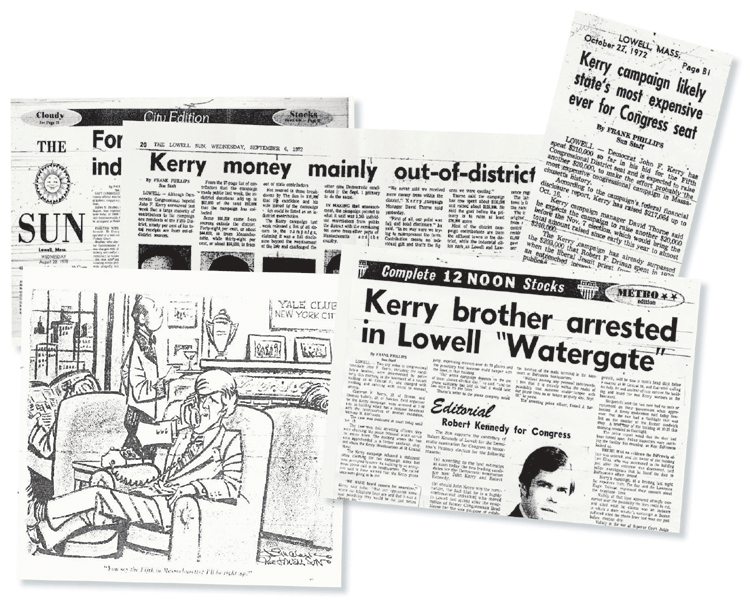
Note: The caption in the cartoon reads: "You say the Fifth in
Massachusetts? I'll be right up."
|
1
posted on
01/25/2004 1:19:08 PM PST by
Hon
To: All
To win the primary, the newcomer overcame the election eve arrest of his
brother, Cameron, and campaign field director Thomas J. Vallely, both then 22,
in the basement of a Lowell building that housed the headquarters of Kerry and
another Democratic contender, state Representative Anthony R. DiFruscia of
Lawrence. It was almost 2 a.m. - 30 hours before the polls opened - when the
two were arrested on charges of breaking and entering with intent to commit
larceny.
That day's Sun blared a memorable, double-deck headline: "Kerry brother
arrested in Lowell `Watergate."' DiFruscia, getting some extra ink in the
campaign's waning hours, had drawn the parallel to the break-in at Democratic
headquarters in Washington three months earlier.
The Kerry camp declared it a setup, saying that the two responded to an
anonymous phone call, minutes earlier, threatening to cut the campaign's 36
phone lines on the day before its get-out-the-vote effort. Lowell Police
arrested the pair in an area near the trunk line for all of the building's
phones.
To this day Kerry becomes animated talking about the episode, convinced it was
part of a conspiracy against his insurgency. He said he does not know who was
involved. He dismissed as ridiculous the charge that DiFruscia was a target.
"He didn't figure in the race," said Kerry.
But some of Kerry's claims in the Lowell break-in are wildly at odds with the
facts.
"That headline was held open. That page was held open, according to [Sun]
typesetters, at 1 o'clock in the morning," Kerry said. "That doesn't happen at
a newspaper, you know that. And that headline was out there on the streets the
next morning, first thing."
The Sun, however, was an afternoon paper, and its first deadline was hours
after the arrests, in plenty of time to write the story for that day's
editions. The Eagle-Tribune of Lawrence also reported the arrests that day, in
a smaller story under the headline "Shades of Watergate?"
Kerry's brother today declines to elaborate on the circumstances surrounding
the arrests and the charges, which were dropped a year later.
"It was an impulsive, rash thing that we did and that John Kerry ended up
having to deal with," said Cam Kerry, now a partner at the Boston law firm of
Mintz Levin Cohn Ferris Glovsky and Popeo. "That's all we're going to say on
that one."
Vallely, a former Marine who served in Vietnam and later became a state
representative in Boston, had more to say.
"I kicked in the door," he said, and then, police swarmed the area. Vallely
said DiFruscia's office was of no interest; the Kerry phone lines were. In
hindsight, he said, "We probably were overreacting to someone who was joking."
http://www.boston.com/globe/nation/packages/kerry/061803.shtml
2
posted on
01/25/2004 1:21:53 PM PST by
Hon
To: Hon
Thanks for the post. Interesting.
3
posted on
01/25/2004 1:22:06 PM PST by
Cautor
To: Mo1; Miss Marple; Peach; prairiebreeze; cyncooper; Howlin
This is how Chris Lehane works his black magic...
4
posted on
01/25/2004 1:26:19 PM PST by
Dog
("America will never seek a permission slip to defend the security of our
Country")
To: All
Kerry has just been smacked by Chris Lehane.
5
posted on
01/25/2004 1:28:49 PM PST by
Dog
("America will never seek a permission slip to defend the security of our
Country")
To: Hon
Interesting...
6
posted on
01/25/2004 1:28:55 PM PST by
Bogey78O (Why are we even having this debate?)
To: Hon
I'm hoping that Howie Carr knows some interesting tidbits about our
horse-faced Senator. I know Howie thought it pretty funny that Kerry keeps
talking about "special interests". I guess he's the King of "special
interests". Howie, if you're a lurker, which I'm pretty certain you are, start
spilling the beans on John Forbes Kerry.
7
posted on
01/25/2004 1:29:39 PM PST by
surrey
To: Bogey78O; Howlin
Beats the evening deadline so it can get in tomorrow mornings newspaper and
will be repeated all day on the cable networks. Watch Drudge feature this
later .....might even rate a siren and light.
8
posted on
01/25/2004 1:31:28 PM PST by
Dog
("America will never seek a permission slip to defend the security of our
Country")
To: Dog
Vallely on Ketchup Boy. From
this link a quote:
“John needs a kind of tension to be at his best,” the article quoted
Thomas Vallely, a Vietnam vet and close friend of Kerry. “Part of him needs
the high-wire act.”
This from Ketchup Boy's friend and advisor...
9
posted on
01/25/2004 1:33:08 PM PST by
mewzilla
To: Dog
Kerry has just been smacked by Chris LehaneLehane: the king of
political porn strikes again, this time hitting the French-looking candidate
who believes we need a permission slip from the UN before we can protect our
national security.
10
posted on
01/25/2004 1:36:09 PM PST by
Cautor
To: Dog
Well we need to slow him down so Dean can catch up.
Heaven help us if they latch on to Edwards. EH's really their best chance of
beating Bush.
11
posted on
01/25/2004 1:37:55 PM PST by
Bogey78O (Why are we even having this debate?)
To: All
12
posted on
01/25/2004 1:38:42 PM PST by
Hon
To: Dog
LOL .. with pictures of the paper too !
13
posted on
01/25/2004 1:39:14 PM PST by
Mo1
(Join the dollar a day crowd now!)
To: Cautor
I was wondering when he would strike. Cutting it a little close with this
one.....wonder what major media outlet picks this up first. I know Lehane
shopped this to several outlets so when this breaks ....it will overwhelm the
Kerry camp.
That is the Lehane MO.....and how he almost did Bush in with the
DUI charge..
14
posted on
01/25/2004 1:39:50 PM PST by
Dog
("America will never seek a permission slip to defend the security of our
Country")
To: Hon
bump for later read
15
posted on
01/25/2004 1:40:01 PM PST by
I_be_tc
To: Mo1
I love politics..
16
posted on
01/25/2004 1:40:40 PM PST by
Dog
("America will never seek a permission slip to defend the security of our
Country")
To: Hon
Click
here for both
parts of John Pike's article
The Many Faces of John Kerry.
17
posted on
01/25/2004 1:40:45 PM PST by
mewzilla
To: Dog
Is Mary Beth Cahill still Ketchup Boy's campaign manager? If so, with her
around, who needs to worry about Lehane?
18
posted on
01/25/2004 1:41:48 PM PST by
mewzilla
To: mewzilla
Hey mew did Lehane call you....LOL!
19
posted on
01/25/2004 1:42:09 PM PST by
Dog
("America will never seek a permission slip to defend the security of our
Country")
To: Dog
In his dreams :)
20
posted on
01/25/2004 1:43:06 PM PST by
mewzilla
To: Dog
LOL .. so do I
And Dang I have to go to my laws now, could ya ping me to anything good you
see?
21
posted on
01/25/2004 1:43:22 PM PST by
Mo1
(Join the dollar a day crowd now!)
To: Dog
I love politics too, but this year is going to be a doozy, if I survive..LOL
22
posted on
01/25/2004 1:43:55 PM PST by
mystery-ak (Almighty God, Embrace with Your invincible armour our loved
ones in all branches of the service.)
To: Mo1
Will do...
23
posted on
01/25/2004 1:44:04 PM PST by
Dog
("America will never seek a permission slip to defend the security of our
Country")
To: Hon
What is the tagline under the cartoon?
24
posted on
01/25/2004 1:44:39 PM PST by
expatpat
To: Dog
Cutting it a little close with this oneI agree. But just a few short
days ago, Kerry didn't look like he needed whacking because his campaign was
tanking in NH and elsewhere. Ketchup boy came on fast and furious.
25
posted on
01/25/2004 1:45:28 PM PST by
Cautor
To: expatpat
It's above it:
Note: The caption in the cartoon reads: "You say the Fifth in Massachusetts?
I'll be right up."
This is a reference to how Kerry shopped around for a Congressional District
to run in. That's a scandal in itself.
26
posted on
01/25/2004 1:47:23 PM PST by
Hon
To: All
"But some of Kerry's claims in the Lowell break-in are wildly at odds with the
facts."
And this is from the Boston Globe!
27
posted on
01/25/2004 1:54:23 PM PST by
Hon
To: Bogey78O
Heaven help us if they latch on to Edwards. EH's really their best chance
of beating Bush. Hubby and I have been saying this for at least a week.
28
posted on
01/25/2004 2:02:28 PM PST by
annyokie (Wesley Clark: Howard Dean with medals!)
To: annyokie
Yea, he'll swing enough votes in the South to maybe capture one or two states
and he's guaranteed the liberal states who are voting ABB- anyone but Bush.
Kerry has that same inocuous appela but not enough to capture swing states.
29
posted on
01/25/2004 2:24:48 PM PST by
Bogey78O (Why are we even having this debate?)
To: Dog
Earlier today Walter Shapiro was being interviewed on Fox and he said that
there could still be "surprises" which might affect the race. I said then (on
the Sunday Talk Show thread) that I thought that Shapiro had caught wind of
something Lehane was floating.
Ta-da!!!
To: Hon; Salvation
The sad part about this article is that everyone (including Republicans)
expect the democRATs (i.e. the Longs', Kennedys', Daleys', etc.) to commit
voter fraud (i.e dead people voting, felons, etc.), electioneering, B&E,
wiretapping, walk-around money, larceny, strong arm tactics, foreign
contributions, etc., etc.
Nothing new here, time to moveon.org (AA).
(AA=anti-American A$$holes) Kinda like the ACLU.
5.56mm
31
posted on
01/25/2004 2:51:13 PM PST by
M
Kehoe
To: Miss Marple
I saw that and I wondered why Shapiro would use the word "surprise" in the way
he did
32
posted on
01/25/2004 3:03:15 PM PST by
MJY1288 (WITHOUT DOUBLE STANDARDS, LIBERALS WOULDN'T HAVE ANY !)
To: Hon
Wonder what Breakins are happening as we read this. He is a constant
Protester, and Side Line Quarterback. I liked reading that Teresa Heinz is
still a Loyal Registered Republican and has never voted for him! Thats
bankable.
To: Dog
"Kerry has just been smacked by Chris Lehane."
I have no idea what you or Miss Marple are trying to suggest with these
remarks.
I found this material myself via Google. Anybody could do it. (In fact, more
people should be doing it.)
34
posted on
01/25/2004 3:41:17 PM PST by
Hon
To: Miss Marple
"Earlier today Walter Shapiro was being interviewed on Fox and he said that
there could still be "surprises" which might affect the race. I said then (on
the Sunday Talk Show thread) that I thought that Shapiro had caught wind of
something Lehane was floating.
Ta-da!!!"
Again, this post is not the handy work of any backroom politicking and it is
laughable that you and others are suggesting this. Do you think it makes you
sound worldly?
If more people would just use their browsers and maybe spend a little less
time chatting, you'd be amazed what you can find. (This is not directed at
you, personally.)
It is also counter-productive to try to suggest that this is just opposition
research. That cheapens my and other people's efforts.
35
posted on
01/25/2004 3:45:39 PM PST by
Hon
To: Dog; Mo1; Miss Marple; Peach; prairiebreeze; cyncooper; Howlin; Cautor
I don't think this is Lehane. Look at the dates on those articles; they're
from last year, when Lehane still worked
for Kerry.
It's too late now
for any Lehane puke politics to have much of an effect on Tuesday's voting. My
guess is that Clark has, with good reason, written off NH to focus more on
other states, and Lehane is thus holding back in case he needs to drop this
bomb later on.
36
posted on
01/25/2004 3:46:21 PM PST by
Timesink (Two fonts walk into a bar. The bartender says, "We don't serve
your type here.")
To: Timesink; Dog
Good catch on the date. The ONLY bomb anyone would need to drop on Clark would
be today's transcript of the Stepanapolous show.
He pulled a Clinton with the word "the". I checked the ABC website and in
order to get a transcript I'd have to fork over $19.95 and knowing ABC,
they've probably expunded the portion I'll repeat here.
George asked Clark why he supported "the Iraq resolution for war last year but
is opposed to it now."
Clark responded "that depends on the meaning of the word 'the'."!!! No joke.
We didn't hear the follow up to that sentence because we were literally
roaring with laughter and a mixture of disgust and anger.
What's with a candidate that he would parse the word "the"; way to Clintonian
for my tastes.
37
posted on
01/25/2004 3:49:21 PM PST by
Peach
(The Clintons have pardoned more terrorists than they ever captured or
killed.)
To: Hon
But if the Kerry campaign was concerned about someone breaking and entering
to cut off its telephone service, why didn't they just call the police?
Best reason in the world: the police were not fond of the protest
movement and no competent political operative would have given them any entry
whatever into the Kerry campaign.
If this 'issue' isn't DOA, it'll only serve to make those who promote it
look like partisan idiots.
38
posted on
01/25/2004 3:51:05 PM PST by
Grut
To: Dog
So who bankrolled Kerry in his first run for Congress.
Who wanted him to win and run so badly, and what did they get in return?
Big Dig connection?
To: All
Turn on C-SPAN....NOW !
40
posted on
01/25/2004 3:55:39 PM PST by
Neenah
To: Hon
In light of the article, I thought it was a reference "to the Fifth".
To: mabelkitty
"So who bankrolled Kerry in his first run for Congress."
This was actually not Kerry's first foray into politics. He had tested the
waters before--as a Vietnam hero. But when that proved to be unpopular, he ran
again later as a war protester.
But it is an interesting question, given that Kerry's campaigns were always
record-setters for being the most expensive to date. This has been true at
every level he has run.
42
posted on
01/25/2004 3:58:14 PM PST by
Hon
To: Peach
Stunning.
Clark's done.
Does anybody know when this and his dereliction of duty in regards to NATO
will make big news?
To: Hon

Sen. John Kerry (D-MA), left, gestures under a bust of Ho Chi Minh, during a
Nov. 1994 meeting in Hanoi with Do Muoi, general secretary of the Communist
Party of Vietnam. In 1955, as a leader in the communist land reform movement,
Muoi helped annihilate Vietnam's middle-class landowners. Over 50,000
Vietnamese landowners were murdered that year, making it one of the bloodiest
periods in Vietnam's history.
44
posted on
01/25/2004 4:04:18 PM PST by
kcvl
To: Hon
Hence, my question - who was desperately trying to get Kerry into Congress and
footing all the bills.
To: mewzilla
“John needs a kind of tension to be at his best,” the article quoted Thomas
Vallely, a Vietnam vet and close friend of Kerry. “Part of him needs the
high-wire act.”Very understandable. Kerry was a SEAL. Knowing many a
Special Ops guy, I truly believe some acquire an strong addiction to
adrenalin.
To: Neenah
What's going on?
To: mewzilla
Senate connection to Riady/Lippo Group.
An indication of just how deep and subtle Red Chinese roots run in U.S.
business and government affairs deals with Sen. John Sidney McCain (R-AZ) and
Sen. John Forbes Kerry (D-MA). Both McCain and Kerry fought long and hard to
provide the political cover Clinton needed when he made the controversial
decision to normalize trade and diplomatic relations with Vietnam.
McCain's current wife, Cindy, is the daughter of James Hensley, who is the
second largest Anheuser-Busch distributor in the United States. Sen. McCain is
an officer in Hensley & Co. and Cindy is a vice president. The McCain family
owns several million dollars in Anheuser-Busch stock.
As a part of an aggressive campaign to enhance its international standing in
the beer market, Anheuser-Busch has been signing contracts and investing
hundreds of millions building brewery operations in China and Vietnam. It
remains unclear whether any of those contracts involve Lippo.
Documents retrieved from the Internet reveal that Riady's Lippo is the holder
of a license for Sea World in Indonesia and that Anheuser-Busch owns all the
Sea World themeparks in the United States as well as some overseas. Again,
this begs the question, is there a connection between Anheuser-Busch and Lippo?
McCain has requested the Justice Department appoint an independent council to
investigate Huang and the Lippo group for the contributions violations. Rep.
Gerald Solomon (R-NY) has asked for investigators to focus on assertions made
by James Riady, that Huang was "my man in the American government."
A member of Sen. Kerry's family, specifically his cousin, C. Stewart Forbes,
is Chief Executive Officer of the Boston, Massachusetts-based Colliers
International, one of the largest real estate federations in the world.
In Dec. 1992, Vietnam granted Colliers a contract designating Colliers the
"exclusive real estate agent representing Vietnam." Colliers has since written
contracts in Vietnam worth billions, upgrading Vietnam's ports, railroads,
highways and government buildings.
Colliers is involved with Lippo in multimillion contracts in Indonesia. Kerry,
who has a blind trust run by members of his family, claims he knows nothing
about his cousin's business deals or affiliations.
http://216.239.41.104/search?q=cache:5Tyc-5o_i7cJ:ojc.org/powforum/editor/lippo2.htm+Senate+connection+to+Riady/Lippo+Group.&hl=en&ie=UTF-8
48
posted on
01/25/2004 4:07:54 PM PST by
kcvl
To: kcvl
How much has the Heinz empire increased in revenue since they've started
distributing their products in Vietnam?
To: mabelkitty
Sunday, December 14, 2003
Post-war rebel
After requesting a discharge so that he could run for Congress -- from
Massachusetts in 1970 -- Kerry dropped out of that race when he found that he
was destined to be a loser.
Then, Kerry found a new cause that already had been active for three years,
and which he today claims as his own. This former naval officer abandoned his
oath of office, joined up with the hard-communist left and now claims to have
founded Vietnam Veterans Against the War, or (VVAW). He did attend their
conference in February 1971 with Jane Fonda -- Hanoi Jane, their most
successful promoter and fund-raiser.
The VVAW made its debut in 1967, in New York City at an anti-Vietnam war
protest that was also planning the disruption of the 1968 Democratic Party
National Convention in Chicago. By the spring of 1970, it numbered several
hundred members and the organization had gone national.
All without John Kerry, who remained in Boston.
Kerry later arrived in Washington for an encampment to protest the war, and to
provide evidence against his country on Capitol Hill, dressed in his fatigues.
Much of the speech Kerry gave to the Senate Foreign Relations Committee
painted his fellow GIs as brutal sadists.
He picked up on the testimony of one Marine Sgt. Scott Camil, who said the
U.S. military had raped, cut off ears, heads and limbs and participated in
many other atrocities. He said that he found the accounts of torture "shocking
and irrefutable."
In the last week of April 1971, some 250,000 protesters were in Washington for
massive protests against the draft and the war. They were preparing for their
attack on the U.S.government on May 4, when they hoped to shut down the
capital. Kerry was everywhere, now promoting the pro-communist People's Peace
Treaty, drawn up in East Germany and developed by Tom Hayden and Rennie Davis.
The treaty advocated the communist line to withdraw all U.S.troops from
Vietnam and then negotiate with Hanoi for the release of our GIs who had been
taken prisoner.
But Kerry lost his support base, even then, by playing both sides. He attacked
the May Day rioters as criminals for the looting, tire-slashing and
window-breaking.
Kerry turned himself from a nonentity into a national icon. Since then, he has
married twice, and his partner today is Teresa Heinz Kerry, the widow of
Pennsylvania's late Sen. John Heinz. Teresa, despite this marriage in 1995, is
a very bright and accomplished woman who, notwithstanding her 65 years, would,
without the encumbrance of her present husband, have had a remarkable career.
But it is John Kerry who has had a more than remarkable career.
As long ago as June 1971, a reporter for the Marxist Liberated Guardian
described how Kerry was raising money from Wall Street's liberal elite, led by
Edgar Bronfman, president of Seagram's Distillers, who gave $5,000 of 1971
money. The writer, a true Marxist, bemoaned that the donors had previously
supported the Vietnam War, and wrote: "Most of these financiers of political
movements are only interested in 'future access to the White House.' Does
Kerry want to be in the White House someday? And if he were, how would he
answer their calls?"
The Democrats of the left have waited 32 years to find out what makes John
Kerry tick. Now, they are finding out the truth.
Dateline D.C. is written by a Washington-based British journalist and
political observer.
50
posted on
01/25/2004 4:10:10 PM PST by
kcvl
Navigation: use the links below to view more comments.
first
1-50, 51-100, 101-115
next
last
Disclaimer: Opinions posted on Free Republic are those
of the individual posters and do not necessarily represent the opinion of Free
Republic or its management. All materials posted herein are protected by
copyright law and the exemption for fair use of copyrighted works.
FreeRepublic.com is powered by software copyright 2000-2003 Robinson-DeFehr
Consulting, LLC.
FreeRepublic.com
"A Conservative News Forum"
Click to scroll to commentary.
John Kerry's Watergate
Insight on the News ^ | Sept 16, 2003 | John Pike
Posted on 01/25/2004 1:19:08 PM PST by
Hon
click here to read article
Navigation: use the links below to view more comments.
first
previous
1-50, 51-100, 101-115
next
last
To: mabelkitty
I don't know. But as you probably are aware, he was close to the Kennedys
then, as he has been most of his life:

51
posted on
01/25/2004 4:12:58 PM PST by
Hon
To: mabelkitty
Kerry spokeswoman Kelley Benander , confirmed that aides to Kerry, who hired
Clinton White House opposition researcher Mike Gehrke last spring, have begun
scouring the public backgrounds of Democrats on the White House campaign trail
as well as President Bush. ‘We are certainly getting up to speed on the public
records of all the candidates in the race, including our own,’ she said. ‘We
also thoroughly scrub John Kerry's background to prepare him from attacks from
George W. Bush and his right-wing allies.’
Kerry putting `mean Mike' to work; Anita Hill at play in Boston. (the
insider).(various; John Kerry hires Mike Gehrke and Anita Hill dating playboy)
Insight on the News, Feb 18, 2003
Insiders expect Sen. John Kerry (D-Mass.) to run one of the meanest
presidential campaigns in memory, having just hired Mike Gehrke, chief of
"opposition research" at the Clinton White House, to dig up dirt on his
opponents.
Research Director
Mike Gehrke
Worked at the DSCC, 2001-2003. Research Director in the Clinton White House,
1999 to Jan. 2001. Worked with AFL-CIO Political Department/Labor '98 program,
1997-99. Research Director for Citizen Action, 1995-97.
Campaign Manager
Jim Jordan
Spokesman for Democrats on the House Judiciary Committee during the 1998
impeachment hearings of President Clinton and for Democrats on the Senate
Governmental Affairs Committee during the 1997 campaign finance investigation.
Deputy Campaign Manager
Marcus Jadotte
During the Clinton administration he worked in the Department of Labor in the
Office of the Deputy Secretary and in Congressional and Intergovernmental
Affairs. In 1998 he served as political director on the MacKay-Dantzler
campaign for governor of Florida. In 1996 he was a regional director on the
Clinton-Gore re-election campaign in Florida.
Communications Director
David J. Morehouse
During the first term of the Clinton Administration, Morehouse served in a
number of senior positions including Director of Strategic Planning in the
White House Office of National Drug Control Policy (ONDCP).
Treasurer
Robert Farmer
Farmer gained fame as finance director for Michael Dukakis' 1988 presidential
campaign. Earlier he raised money for John Anderson's independent campaign in
1980 and John Glenn's 1984 campaign. In 1992 raised money for Bill Clinton's
campaign and he then gained the position of U.S. consul general to Bermuda.
Advance Director
Greg Hale
(started Aug. 2003) Prior to joining the campaign Hale was working at
consulting in Little Rock. Worked on Clinton/Gore '96 and then in the White
House. Graduate of the University of Arkansas. (source:AP)
Senior Strategist
Jill Alper
Coordinated Campaign Director at the DNC, 1994-96. Other campaign experience
includes: Michigan State Director for Clinton/Gore in 1992;
State Director
Mario Diaz
Before joining the Kerry campaign, Diaz was a longtime aide to Janet
Napolitano. He worked with Napolitano starting in 1993, when President Clinton
appointed her U.S. attorney for Arizona.
State Director
Paul Rivera
(started March 2003) Has worked on the campaigns of Carl McCall (2002) and
Hillary Rodham Clinton (2000), three Democratic Conventions and the 1996 and
2000 Presidential Elections.
David Wilhelm
Wilhelm is president of Wilhelm & Conlon Public Strategies, founded in 1998.
He managed Bill Clinton’s 1992 presidential campaign, and subsequently served
as the chair of the DNC
Angelique Pirozzi served as campaign manager of the Kerry Committee, Sen.
Kerry's re-election campaign. Previously, she directed the Democrats'
coordinated campaign in Wisconsin in Fall 2000, and she worked on the
Clinton/Gore campaign in New Hampshire in 1996.
52
posted on
01/25/2004 4:14:28 PM PST by
kcvl
To: XHogPilot
"Kerry was a SEAL."
Wrong Kerry.
53
posted on
01/25/2004 4:15:39 PM PST by
Hon
To: Dog
"Kerry has just been smacked by Chris Lehane."
Even the devil does God's work at times.
54
posted on
01/25/2004 4:17:02 PM PST by
ShandaLear (Howard Dean STILL isn't any safer!)
To: Hon

President Bill Clinton, Sen. John Kerry (D-MA) and Sen. John McCain (R-AZ)
congratulate each other at 1995 White House ceremony normalizing relations
with Vietnam.
55
posted on
01/25/2004 4:18:27 PM PST by
kcvl
To: Hon
In December of 1992, not long after Kerry was quoted in the world press
stating "President Bush should reward Vietnam for its increased cooperation in
accounting for American MIAs," Vietnam announced it had granted Boston,
Massachusetts based
Colliers International, a contract worth billions
designating Colliers International as the exclusive real estate agent
representing Vietnam. That deal alone put Colliers in a position to make
tens of millions of dollars (after the U.S. normalized trade relations) on the
rush to upgrade Vietnam's ports, railroads, highways, government buildings,
etc.
C. Stewart Forbes, Chief Executive Officer of Colliers International, is
Kerry's cousin.
56
posted on
01/25/2004 4:20:18 PM PST by
kcvl
To: Hon
Looks like Lehane may have dug a big hole in turn 2 of the Freakness. And
Secrekerryat just hit it.
To: XHogPilot
Very understandable. Kerry was a SEAL. Knowing many a Special Ops guy, I
truly believe some acquire an strong addiction to adrenalin.Wrong
Kerry. You're thinking of Senator Bob, late of Nebraska and currently of the
Haaavahd school of government.
You remember his famous statement back about 1993: "Clinton's an unusually
good liar".
To: small voice in the wilderness
59
posted on
01/25/2004 4:22:29 PM PST by
kcvl
To: Timesink
June 1971, a reporter for the Marxist Liberated Guardian described how Kerry
was raising money from Wall Street's liberal elite, led by
Edgar Bronfman,
president of Seagram's DistillersUnder Edgar Sr., Seagram expanded
overseas and extended itself into real estate and oil.
60
posted on
01/25/2004 4:29:13 PM PST by
kcvl
To: Mo1; Miss Marple; Howlin; Dog
Edgar Bronfman, president of Seagram's Distillers
John Kerry is Austrian Jew
and not English Irish as he has claimed inthe past once saying he was "proud
of his English Irishancestry".......in the past he has accepted money from
Edgar Bronfman,who with Meyer Lansky - ran Murder Inc.
61
posted on
01/25/2004 4:33:52 PM PST by
kcvl
Bronfman Family
Edgar M. Bronfman
Founder, Scandent Group
Edgar M. Bronfman is a member of the Board of Directors of Vivendi Universal.
Prior to the December 2000 formation of Vivendi Universal, Mr. Bronfman was
Chairman of The Seagram Company Ltd. In 1951, Mr. Bronfman joined Distillers
Corporation-Seagrams Limited (renamed The Seagram Company Ltd. in 1975),
becoming president of the company in 1971 and Chairman in 1975. In 1994, Mr.
Bronfman relinquished the position of Chief Executive Officer to his son,
Edgar Bronfman, Jr.
Mr. Bronfman 's philanthropic and civic activities include serving as Chairman
of The Samuel Bronfman Foundation. In 1999, President Clinton awarded Mr.
Bronfman the Presidential Medal of Freedom, the United States' highest
civilian honor. That same year, Mr. Bronfman received an Honorary Doctor of
Humane Letters from the University of Rochester. In 1997, he received from New
York University an honorary degree of Doctor of Commercial Science.
Mr. Bronfman attended Trinity College School in Port Hope, Ontario, Canada;
Williams College in Williamstown, Massachusetts; and graduated with a
bachelor's degree from McGill University in Montreal, Canada, in 1951.
Edgar Bronfman Jr.
Founder, Scandent Group
Edgar Bronfman Jr. is the Vice Chairman of Vivendi Universal, a leading global
media & communications company, with operations in five core communication
units including TV & Film, Publishing, Music, Internet and Telecom. Its
environmental unit, Vivendi Environment, is the worldwide leader in
environment services. He has been instrumental in bringing Universal and
Vivendi together to form one of the world's most significant conglomerates.
Prior to the December 2000 formation of Vivendi Universal, Edgar Bronfman Jr.
was President and Chief Executive Officer of The Seagram Company Limited, a
post he held since June 1994. He has held various leadership positions, which
include Managing Director - Europe, based in London, overseeing management of
Seagram's European subsidiaries and affiliates. He has also been responsible
for the US operations and has supervised all spirit & wine activities in the
United States and the marketing efforts of Tropicana Products Inc. He built
the Seagram business and brands to a position of significant strength. During
his tenure as the Chief Executive Officer of Seagram, he consummated
approximately US $ 85 billion in transactions and transformed the company into
one of the world's leading media and communications company.
He is a member of the Board of USA Networks Inc., The New York University
Medical Center and The Wharton School of the University of Pennsylvania,
amongst others. Edgar Bronfman Jr. brings to Scandent Group invaluable
leadership and experience in building global businesses and in transforming
businesses to compete in challenging environments.
62
posted on
01/25/2004 4:41:43 PM PST by
kcvl
To: Seamonster
I liked reading that Teresa Heinz is still a Loyal Registered Republican
and has never voted for him!
Vote for him? Heck, she doesn't even call him her husband! When she says
"My husband..." she is referring to Heinz - not Kerry. No wonder he's got a
long face.
63
posted on
01/25/2004 4:49:35 PM PST by
ladyjane
Total for this search: $59,650
BRONFMAN, EDGAR M
NEW YORK,NY 10152
VIVENDI UNIVERSAL
8/19/2003
$15,000
Democratic Senatorial Campaign Cmte
BRONFMAN, JOANIE MS
BROOKLINE,MA 02445
SELF/CONSULTANT
10/23/2003
$5,000
Emily's List
BRONFMAN, JOANIE MS
BROOKLINE,MA 02146
SELF/CONSULTANT
10/24/2003
$4,900
League of Conservation Voters
BRONFMAN II, SAM
ATHERTON,CA 94027
SEAGRAM CHATEAU & ESTATE WINES CO./
3/21/2003
$2,000
Northern Californians for Good Govt
BRONFMAN JR, EDGAR
NEW YORK,NY 10021
LEXA PARTNERS LLC/EXECUTIVE
6/4/2003
$2,000
Kerry, John
BRONFMAN, ADAM
PARK CITY,UT 84060
SELF/DEVELOPER
6/20/2003
$2,000
Capps, Lois
BRONFMAN, ANN
WASHINGTON,DC 20008
RETIRED/RETIRED
9/11/2003
$2,000
Stupak, Bart
BRONFMAN, CLARISSA ALCOCK
NEW YORK,NY 10152
N/A/HOMEMAKER
6/30/2003
$2,000
Kerry, John
BRONFMAN, CYNTHIA
PARK CITY,UT 84060
HOMEMAKER
6/20/2003
$2,000
Capps, Lois
BRONFMAN, DANIEL J
SANTA MONICA,CA 90405
GROWTH CAPITAL ASSOCIATES INC./PRES
9/19/2003
$2,000
Kerry, John
BRONFMAN, EDGAR JR
NEW YORK,NY 10021
VIVENDE UNIVERSAL/CEO
2/19/2003
$2,000
Edwards, John
BRONFMAN, EDGAR M
KETCHUM,ID 83340
SEAGRAM/CEO
7/31/2003
$2,000
Kerry, John
BRONFMAN, JOANIE MS
BROOKLINE,MA 02445
SELF-EMPLOYED/PHILANTHROPY
10/28/2003
$2,000
National Cmte for an Effective Congress
BRONFMAN II, SAM
ATHERTON,CA 94027
SEAGRAM CHATEAU AND ESTATE WINES/EX
6/30/2003
$1,000
Kerry, John
BRONFMAN II, SAMUEL
ATHERTON,CA 94027
DIAGEO NO. AMERICA/CHAIRMAN - GLOBA
2/18/2003
$1,000
Lantos, Tom
BRONFMAN, EDGAR
NEW YORK,NY 10152
JOSEPH E SEAGRAM AND SON INC
1/27/2003
$1,000
Clinton, Hillary Rodham
BRONFMAN, EDGAR JR
NEW YORK,NY 10021
LEXA PARTNERS LLC
6/2/2003
$1,000
Schumer, Charles E
BRONFMAN, EDGAR JR
NEW YORK,NY 10021
LEXA PARTNERS LLC
6/2/2003
$1,000
Schumer, Charles E
BRONFMAN, EDGAR JR
NEW YORK,NY 10022
LEXA PARTNERS LLC
5/13/2003
$1,000
Leahy, Patrick
BRONFMAN, EDGAR JR
NEW YORK,NY 10022
LEXA PARTNERS LLC
6/30/2003
$1,000
Leahy, Patrick
BRONFMAN, EDGAR JR
NEW YORK,NY 10022
LEXA PARTNERS LLC
6/30/2003
$1,000
Leahy, Patrick
BRONFMAN, MATTHEW
NEW YORK,NY 10021
ACI CAPITAL
2/18/2003
$1,000
Schumer, Charles E
BRONFMAN, MATTHEW
NEW YORK,NY 10021
ACI CAPITAL/MANAGING DIRECTOR
4/17/2003
$1,000
Lieberman, Joe
BRONFMAN, MATTHEW
NEW YORK,NY 10021
ACI CAPITAL/MANAGING DIRECTOR
5/12/2003
$1,000
Gephardt, Richard A
BRONFMAN, SAM MR
ATHERTON,CA 94027
SEAGRAM CHATEAU & ESTATE WINES/PRES
5/16/2003
$1,000
Wine Institute
BRONFMAN, SAMUEL
ATHERTON,CA 94027
DIAGEO PLC
2/25/2003
$1,000
Boxer, Barbara
BRONFMAN, SAMUEL
ATHERTON,CA 94027
DIAGEO PLC
2/25/2003
$1,000
Boxer, Barbara
BRONFMAN, SAMUEL
ATHERTON,CA 94027
DIAGEO PLC/CONSULTANT
9/19/2003
$1,000
Kerry, John
BRONFMAN, SHERRY
NEW YORK,NY 10023
NOT EMPLOYED/HOMEMAKER
4/25/2003
$500
Braun, Carol Moseley
BRONFMAN, MATTHEW
NEW YORK,NY 10022
ACI CAPITAL/MANAGING DIRECTOR
6/16/2003
$250
Democratic Cmte of New York State
BRONFMAN, SAMUEL
ATHERTON,CA 94027
3/10/2003
($1,000)
Kerrey, Bob
64
posted on
01/25/2004 4:49:36 PM PST by
kcvl
To: Timesink; Hon
Oops. You are correct, Timesink. I should have noted the date.
So, if
Shapiro was correct on Fox today, there is STILL a bomb to drop.
Hon, you are misunderstanding what I am saying. Although this article is
not the result of Chris Lehane's opposition research, many of the scandals
that drop in the last few days of various primary campaigns will be. Just
because it appears in a paper doesn't mean that the story didn't come from an
opponent of Kerry's. Opposition research is very often leaked to a friendly
media outlet. That is how it becomes a story, rather than a charge by the
opposing candidate.
And excuse me,Hon, but I spend quite a bit of time researching things
myself. This is a good story and I am glad it was posted.
To: Hon

Iowa voters agree: any Democratic presidential contender who can kite-board is
probably the best man for the job
Do we really need a spoiled brat who
is still acting like a teenager in the White House?
66
posted on
01/25/2004 4:57:37 PM PST by
kcvl
To: Miss Marple
"Opposition research is very often leaked to a friendly media outlet. That is
how it becomes a story, rather than a charge by the opposing candidate."
The hell you say!
Anyway, if it was the product of opposition research they sure aren't doing
much with it--since, as I noted, the guy they burglered is now a
Representative in New Hampshire. So there is local interest.
67
posted on
01/25/2004 5:01:15 PM PST by
Hon
To: Hon
I hope somebody has something better than this. ;-)
68
posted on
01/25/2004 5:03:44 PM PST by
Scenic Sounds (Sí, estamos libres sonreír otra vez - ahora y siempre.)
To: Hon
Thx
69
posted on
01/25/2004 5:05:13 PM PST by
expatpat
To: kcvl
Maybe Kerry is taking his Jack Kennedy aping a little too far. Just because
JFK's dad was a bootlegger, doesn't mean Kerry has to be in the pocket of
another.
70
posted on
01/25/2004 5:06:57 PM PST by
Hon
To: Dog
go Lehane!
71
posted on
01/25/2004 5:14:59 PM PST by
Salvation (†With God all things are possible.†)
To: mewzilla
72
posted on
01/25/2004 5:17:12 PM PST by
Salvation (†With God all things are possible.†)
To: mabelkitty
**So who bankrolled Kerry in his first run for Congress.
Who wanted him to win and run so badly, and what did they get in return?
Big Dig connection?**
I've always thought:
Kennedy.
73
posted on
01/25/2004 5:20:15 PM PST by
Salvation (†With God all things are possible.†)
To: Seamonster
"I liked reading that Teresa Heinz is still a Loyal Registered Republican and
has never voted for him! Thats bankable."
Actually she very publicly changed her voter registration to Dem last January.
(Over some trumped up reason vis a vis Rick Santorum.)
But when she married Kerry she said that she would "go down the aisle with
him, but she wouldn't cross the aisle for him."
That changed. LOL
74
posted on
01/25/2004 5:20:19 PM PST by
Hon
To: kcvl
Wasn't he ice skating with a hockey team yesterday too?
This man needs to grow up! He's worse than Dean!
75
posted on
01/25/2004 5:25:34 PM PST by
Salvation (†With God all things are possible.†)
Fascinating. Not surprising though. Also not surprising is the fact that it
has resurfaced as Kerry becomes the frontrunner.
76
posted on
01/25/2004 6:02:39 PM PST by
SunkenCiv (To reiterate, the nomination fight will be a bloodbath.)
To: Hon
I can't apply a different standard to Kerry than I would to any Republican. He
is not responsible for the actions of his family members unless he caused them
to do this. Has that been shown?
77
posted on
01/25/2004 6:08:28 PM PST by
lawdude (Liberalism: A failure every time it is tried!)
To: kcvl
But I thought only Dick Cheney and Halliburton did shady backroom deals! How
could this be.
78
posted on
01/25/2004 6:08:37 PM PST by
HRoarke (Benedict Arnold was a Veteran too!)
To: Torie
LeHane is a busy little bee.
79
posted on
01/25/2004 6:13:04 PM PST by
jwalsh07
To: Hon
"That changed. LOL"
Words are cheap. I bet she pulls the lever on "R".
80
posted on
01/25/2004 6:24:07 PM PST by
lawdude (Liberalism: A failure every time it is tried!)
To: Timesink; Dog
I don't think this is Lehane. Look at the dates on those articles; they're
from last year, when Lehane still worked for Kerry.Well this story did
appear in the Boston Globe
First campaign ends in defeat - By Brian C. Mooney, Globe Staff, 6/18/2003
To win the primary, the newcomer overcame the election eve arrest of his
brother, Cameron, and campaign field director Thomas J. Vallely, both then 22,
in the basement of a Lowell building that housed the headquarters of Kerry and
another Democratic contender, state Representative Anthony R. DiFruscia of
Lawrence. It was almost 2 a.m. - 30 hours before the polls opened - when the
two were arrested on charges of breaking and entering with intent to commit
larceny.
That day's Sun blared a memorable, double-deck headline: "Kerry brother
arrested in Lowell `Watergate."' DiFruscia, getting some extra ink in the
campaign's waning hours, had drawn the parallel to the break-in at Democratic
headquarters in Washington three months earlier.
81
posted on
01/25/2004 6:29:03 PM PST by
Mo1
(Join the dollar a day crowd now!)
To: mewzilla
I hope this isn't the same Vallely who appears frequently on FoxNews.
82
posted on
01/25/2004 6:31:28 PM PST by
DLfromthedesert (What is the point of fighting in Iraq if we surrender to
Vicente?)
To: Timesink; Dog; Peach; prairiebreeze
83
posted on
01/25/2004 6:39:29 PM PST by
Mo1
(Join the dollar a day crowd now!)
To: mewzilla; Dog; Peach; prairiebreeze
Is Mary Beth Cahill still Ketchup Boy's campaign manager? If so, with her
around, who needs to worry about Lehane?
I read last night that Gephardt's Chief of staff, Steve Elmendorf is now
working for Kerry
Kerry
makes switch, hires Gephardt's staff chief
84
posted on
01/25/2004 6:46:43 PM PST by
Mo1
(Join the dollar a day crowd now!)
To: kcvl
Colliers is involved with Lippo in multimillion contracts in Indonesia.
Kerry, who has a blind trust run by members of his family, claims he knows
nothing about his cousin's business deals or affiliations.
Interesting ... thanks for the infor Kcvl
85
posted on
01/25/2004 6:56:51 PM PST by
Mo1
(Join the dollar a day crowd now!)
To: kcvl
Gee .. could Bronfman be considered a special interest????
86
posted on
01/25/2004 7:05:01 PM PST by
Mo1
(Join the dollar a day crowd now!)
To: jwalsh07
Yep. Politics is a contact sport. The trick is to get the dirt on yourself out
at the right time (not too early, and not too late). Bush not getting out the
DUI earlier made the election most interesting (had to know if that was what
caused the drop, or his misstep on social security, or just Dems coming home
and Gore's on the ground machine, but something did). Bush did a favor for
political psephologists and political junkies everywhere.
87
posted on
01/25/2004 7:14:40 PM PST by
Torie
To: Torie

President? I DON'T THINK SO!!!
88
posted on
01/25/2004 7:27:19 PM PST by
kcvl

President? NO...

President? No, not him either...
89
posted on
01/25/2004 7:32:17 PM PST by
kcvl

President...HAHAHAHAHA!

Now, THIS IS A PRESIDENT!!!
90
posted on
01/25/2004 7:34:18 PM PST by
kcvl
91
posted on
01/25/2004 7:35:18 PM PST by
kcvl
92
posted on
01/25/2004 7:36:09 PM PST by
kcvl
To: Dog
I wonder if this is what Sean was talking about.
To: Torie
Dean supporters are pushing back. Backlash against the media and establishment
push against Dean is ripe to happen in New Hampshire where the liberals are
more liberal and the voters more ornery than in Iowa.
94
posted on
01/25/2004 7:55:56 PM PST by
jwalsh07
To: Mo1
Good article about the tax shelter
95
posted on
01/25/2004 7:57:39 PM PST by
prairiebreeze (God Bless and Protect the Allied Troops. And the families
here at home---they are soldiers too.)
To: prairiebreeze
And he wants to raise taxes??
What was it that Kerry said about rich people?
96
posted on
01/25/2004 8:02:48 PM PST by
Mo1
(Join the dollar a day crowd now!)
To: Hon
97
posted on
01/25/2004 8:02:50 PM PST by
ALOHA RONNIE (Vet-Battle of IA DRANG-1965 www.LZXRAY.com.)
To: jwalsh07
You must be a big fan of the Zogby poll. Who knows what will happen. I have
decided that in this election cycle, I just can't predict what Democrats will
do in primaries. (The Dems in the hunt really don't disagree on anything much,
so it is just one of those instinctual things as to who the Dems think has the
right stuff to beat Bush, while being perceived as no more than one standard
deviation away from the median human stability index.) I am worthless.
98
posted on
01/25/2004 8:04:52 PM PST by
Torie
To: Dog
Chris la Anus as Rush calls him.
To: Peach
Oh man...I saw the interview that Steponallofus did with Weird Wesley
Clark..."depends on what "THE" means!!!! OMG!! What's in the Little Rock
Water???? Clark is CERTIFIABLE!!
Navigation: use the links below to view more comments.
first
previous
1-50, 51-100, 101-115
next
last
Disclaimer: Opinions posted on Free Republic are those
of the individual posters and do not necessarily represent the opinion of Free
Republic or its management. All materials posted herein are protected by
copyright law and the exemption for fair use of copyrighted works.
FreeRepublic.com is powered by software copyright 2000-2003 Robinson-DeFehr
Consulting, LLC.
FreeRepublic.com
"A Conservative News Forum"
Click to scroll to commentary.
John Kerry's Watergate
Insight on the News ^ | Sept 16, 2003 | John Pike
Posted on 01/25/2004 1:19:08 PM PST by
Hon
click here to read article
Navigation: use the links below to view more comments.
first
previous
1-50, 51-100, 101-115
last
To: Torie
Zogby is good when he wants to be but my hunches are derived from anecdotal
straw polling of lefty leaning family members by marriage who occupy the hills
of NH.
To: XHogPilot
I have NEVER heard Ketchup Face Kerry referred ato as a SEAL!! Are you
positive???
To: Mo1
Somewhere I just read that Kerry and Mrs. Heinz are worth $500 million. Can't
find the source now though.
Lets see. Kerry's party usually argue that tax cuts benefit only the rich.
That rich people don't pay enough taxes because they use loopholes etc. And
that Republicans are the party of the rich.
$500 million. Quite a chunk of change there, and catapults Kerry from the very
rich to the stinkin' rich IMO.
Prairie
103 posted on
01/25/2004 8:16:39 PM PST by
prairiebreeze (God Bless and Protect the Allied Troops. And the families
here at home---they are soldiers too.)
To: prairiebreeze
Lets see. Kerry's party usually argue that tax cuts benefit only the rich.
That rich people don't pay enough taxes because they use loopholes etc. And
that Republicans are the party of the rich.
Did you here about Edwards plans?
His health care and education plan, he says will cost us the taxpayers 53
BILLION dollars
104 posted on
01/25/2004 8:22:25 PM PST by
Mo1
(Join the dollar a day crowd now!)
To: jwalsh07
IC. Maybe with your connections you can wangle a ticket to the inaugural ball
for Dean then. Heck, even my younger brother knows Dean is a nutter, and he
thinks the Dems should push Bush as a coke snorter and a deserter as a
political issue. I tried to explain to him that recycling old issues without
new information that did not defeat the now incumbent last time, was not
likely to gain traction, but I failed to dissuade him.
105 posted on
01/25/2004 8:22:59 PM PST by
Torie
To: Mo1
"The problem with socialism is that you eventually run out of other people's
money." ~~ Margaret Thatcher
106 posted on
01/25/2004 8:24:36 PM PST by
prairiebreeze (God Bless and Protect the Allied Troops. And the families
here at home---they are soldiers too.)
To: prairiebreeze
"The problem with socialism is that you eventually run out of other
people's money." ~~ Margaret Thatcher
I wish a reporter would asked them, what happens when they tax us so much
and there ain't nothing left?
107 posted on
01/25/2004 8:26:23 PM PST by
Mo1
(Join the dollar a day crowd now!)
To: Ann Archy
I have NEVER heard Ketchup Face Kerry referred ato as a SEAL!! Are you
positive???My bad. It was the other Senator Kerrey. Several Freepers
corrected me after my post.
To: kcvl
Bump for later read.
To: Hon; VietnamOdyssey; VOA; Fred Mertz; 68-69TonkinGulfYatchClub; onyx;
Republic; kristinn; ...
.
NEVER FORGET
Just for the CLARITY of it:
'Early KERRY: Disband CIA, Put U.S. Troops Under U.N. Control'
http://www.Newsmax.com/archives/ic/2004/1/25/214708.shtml
QUOTE
GI's in Vietnam, KERRY said, had "personally raped [Vietnamese civilians] cut
off ears, cut off heads, taped wires from portable telephone to human genitals
and turned up the power, cut off limbs, blown up bodies, randomly shot at
civilians, razed villages in a fashion reminiscent of Genghis Kahn."
KERRY later admitted he hadn't personally witnessed any of the atrocities he
claimed his fellow soldiers had committed.
UNQUOTE
NEVER FORGET
.
110 posted on
01/25/2004 9:51:08 PM PST by
ALOHA RONNIE (Vet-Battle of IA DRANG-1965 www.LZXRAY.com.)
To: ALOHA RONNIE
Bump!
To: Carolinamom
Monday :: November 24, 2003
John Kerry's Wife Weighs in on Guantanamo
Theresa Heinz Kerry weighed in on the Guantanamo detainees in Seattle. She
said the detainees deserve prisoner of war status:
"They were captured while fighting a war," Teresa Heinz Kerry said at an
informal discussion with minority activists in Seattle. "They should have the
rights that other prisoners of war have had."
Heinz Kerry, the heir to the Heinz family's food fortune, said denying the
detainees the protections of the Geneva Convention is "insulting, ignorant and
insensitive" to the rest of the world.
She added that under President Bush, the United States, once known as the
standard-bearer for human rights, is now considered a hypocrite. "The
arrogance shown by this administration on human rights and in its foreign
policy is horrible," she said.
So, does husband John agree? The article says yes, but if you read his
position, the answer is no.
A spokeswoman for the Kerry campaign said Sen. Kerry supports his wife's
position that the detainees should be given basic protections such as the
right to an attorney. "As long as al-Qaida is actively trying to take down
America, Sen. Kerry believes that these prisoners should be held as enemy
combatants," spokeswoman Stephanie Cutter said.
Unless Cutter got her candidate's position wrong, she's saying Kerry agrees
with Bush, rather than his wife. Bush has emphatically and continuously
insisted that enemy combatants are not prisoners of war and do not receive the
protections of the Geneva Convention or our Constitution.
Maybe Theresa should be the candidate from the Kerry family.
112 posted on
01/25/2004 11:22:10 PM PST by
kcvl
To: Alamo-Girl
Kerry's wife calls presidential debates 'silly'
via CNN: Boston (AP) -- Teresa Heinz Kerry, the wife of Democratic
presidential candidate John Kerry, says nine-way presidential debates are
"silly" and a waste of time for the candidates and the voters.
"I don't think it really helps the American people, I don't think it helps the
candidates," Heinz Kerry told the Boston Herald in an interview published
Tuesday, the same day her husband was to face his rivals in a debate in his
home town.
Heinz Kerry said debates have become about scoring a punch with quick
soundbites.
"It's just silly," she said. "I think those debates are really unproductive
and they made it hard for all of them to (get their message across)."
Eight of the nine Democrats were scheduled to appear Tuesday night at the
90-minute Rock the Vote forum in Boston that will air on Cable News Network.
Heinz Kerry said she has suggested Democrats focus on smaller group debates
that alternate among all candidates or pick three or four candidates leading
in particular states -- though she conceded the latter idea might not be fair
to all candidates.
Heinz Kerry's comments are in line with frequent complaints from her husband,
who has said the face-offs are not "real debates."
November 4, 2003
113 posted on
01/25/2004 11:24:27 PM PST by
kcvl
To: Mo1
Does Teresa Heinz Trust John Kerry?
If not, why should we?
By Timothy Noah
Posted Tuesday, Dec. 2, 2003, at 5:12 PM PT
If Teresa Heinz won't trust presidential candidate John Kerry with her money,
why should American voters trust Kerry with their country?
Teresa Heinz and Sen. John Kerry, D-Mass., were married in 1995. Kerry's
assets at the time were a few million dollars. (Click here for Kerry's Senate
financial disclosure form for 1995.) Heinz's assets at the time were
reportedly around half a billion dollars, which she'd inherited from her late
husband, Sen. John Heinz, R-Pa., heir to the ketchup fortune. Unlike many
other married couples, Heinz and Kerry kept their premarital assets separate.
Much of Teresa Heinz's inheritance was no doubt tied up in trusts, but a
substantial sum must have been unencumbered, because she had Sen. Kerry sign a
prenuptial agreement. "Everybody has a prenup," Heinz explained to Lisa
DiPaulo, who profiled her sympathetically in Elle.
You have to have a prenup. You've got three kids with somebody else, you've
got to have a prenup. You could be as generous or as sensitive as you want.
But you have to have a prenup.
By all accounts, Teresa Heinz had no interest in becoming first lady during
her 25-year marriage to John Heinz (who died in a 1991 plane crash). "Over my
dead body," she told John. Apparently she spent the first seven years of her
marriage to John Kerry telling him the same thing. According to a Nov. 30
profile by Maeve Reston in the Pittsburgh Post-Gazette, "It was only last year
that she says she changed her mind and told Kerry she would support his
decision to run."
MORE...
http://216.239.39.104/search?q=cache:ooLuoT0ZSyIJ:slate.msn.com/id/2091886+John+Kerry+wife&hl=en&ie=UTF-8
114 posted on
01/25/2004 11:26:21 PM PST by
kcvl
To: ALOHA RONNIE
Wasn't it once rumored that
Bill Clinton desired to be named
head of the United Nations?
115 posted on
01/26/2004 12:09:38 AM PST by
Joy
Angela (GROUND ZERO IS HILLARY's CO-LEGACY)
Navigation: use the links below to view more comments.
first
previous
1-50, 51-100, 101-115
last
Disclaimer: Opinions posted on Free Republic are those
of the individual posters and do not necessarily represent the opinion of Free
Republic or its management. All materials posted herein are protected by
copyright law and the exemption for fair use of copyrighted works.
FreeRepublic.com is powered by software copyright 2000-2003 Robinson-DeFehr
Consulting, LLC.
whosaid
|
| posted on 9-4-2003 at 10:58 PM |


|
|
quote:
Originally posted by The Constitutionalist
quote:
Originally posted by whosaid
quote:
Originally posted by The Constitutionalist
quote:
Originally posted by whosaid
Who's Got Something Against
John
Kerry/ VIETNAM VET?
Uh.....
He's a Demcrat?

Just wondering what you all would come up with.
Kerry also supports increased Hate Crime legislation
and affirmative action.
I may not even vote this time.
Or, possibly vote for La Rouche. But, I know he won't win. La Rouche
really has some big ideas. The repubs and DEMOCRATS really hate him.
That's got to be a plus. I'll study up on him some more.
Most of all, I would DEFINITELY vote for ANY candidate who will
BRING OUR TROOPS HOME ASAP!!!!!
We already have laws and penalties for crimes on the books. Hate crime
legislation and charging someone with a crime of what others believe
that person may have been thinkong when he commited a crime is wrong
when the penalties are already there. Hate crime legislation panders
to one segment of society over another in protection under thread of
penalty over others in society. Hate crimes are not applied on an
equal and fair basis.
agreed
When will Dr. Martin Luther King's dream be realized? When will a man
be given opportunity due to hard work and the content of his
character? Rather, than the color of his skin?
Support for affirmative action panders to just another segment of
society.
agreed
Sure, anyone would like to see our troops come home.
But if were going to go as an isolationist nation as I think you might
like, then we need to dissociate ourselves from the U.N., NATO and all
foriegn protection agreements and alliances we have entered into.
Isolationism is extreme. And, we now have a global economy, like it
or not.
You can't pull trops from one place because you don't like a partcular
president's policies that put them there, while leaving troops
elsewhere.
Bring them all home. The US is not the world's police force.
It's all or nothing.
Another EXTREME statement. "All", meaning we need to intervene in
every conflict? Besides, our? gov't has proven that "all can be
nothing" without world support.
|
|
|
whosaid
|
| posted on 9-4-2003 at 11:03 PM |
|
|
quote:
Originally posted by angry grandma
amen, Larry!
i have read the LaRouche newspapers and i totally oppose his claims
and his philosophy!
talk about FALSE PROPHETS! (is he out of prison yet?)
whosaid will fit right in the LaRouche underground!
especially if he has a KKK background!
[Edited on 9/4/2003 by angry grandma]
Better go back and read your bible for another 40 years, ANGRY grandma!
|
|
|
whosaid
|
| posted on 9-4-2003 at 11:15 PM |
|
|
quote:
Originally posted by Bassman
Mike-I know the NV people were aware of what was going on here-and
that's why I say
Kerry-Heinz is no different than Hanoi Jane.I'm sure they were
made well aware of
Kerry-Heinz and his buddies chucking revered decorations away
as trash.They probably even made movies of it with the usual dialouge
and showed 'em to assemblies at their factories.
While Americans were still fighting and dying.Whether they were dying
for a fucked-up cause or not is completely irrelevant.
If one NV worker or soldier increased his resolve because he saw
Kerry-Heinz,well that's giving aid and comfort.
That's where the line is crossed,IMHO.
He received a Bronze Star for saving the life of a soldier who’d fallen
overboard during a firefight and a Silver Star for chasing down and
killing a Vietcong armed with a rocket launcher. He returned,
disillusioned, and helped found Vietnam Veterans Against the War. He
protested on the lawn of the Capitol, where he famously tossed his
ribbons but not his medals, and testified before the Senate Foreign
Relations Committee, where he posed the question, “How do you ask a
man to be the last man to die for a mistake?”
http://www.johnkerry.com/news/clips/news_2003_0303.html
|
|
|
Bassman
|
| posted on 9-4-2003 at 11:23 PM |
|
|
quote:
Originally posted by whosaid
quote:
Originally posted by Bassman
Mike-I know the NV people were aware of what was going on here-and
that's why I say
Kerry-Heinz is no different than Hanoi Jane.I'm sure they
were made well aware of
Kerry-Heinz and his buddies chucking revered decorations away
as trash.They probably even made movies of it with the usual
dialouge and showed 'em to assemblies at their factories.
While Americans were still fighting and dying.Whether they were
dying for a fucked-up cause or not is completely irrelevant.
If one NV worker or soldier increased his resolve because he saw
Kerry-Heinz,well that's giving aid and comfort.
That's where the line is crossed,IMHO.
He received a Bronze Star for saving the life of a soldier who’d
fallen overboard during a firefight and a Silver Star for chasing down
and killing a Vietcong armed with a rocket launcher. He returned,
disillusioned, and helped found Vietnam Veterans Against the War. He
protested on the lawn of the Capitol, where he famously tossed his
ribbons but not his medals, and testified before the Senate Foreign
Relations Committee, where he posed the question, “How do you ask a
man to be the last man to die for a mistake?”
http://www.johnkerry.com/news/clips/news_2003_0303.html
Can't polish a turd like
Kerry-Heinz
and his despicable actions at the Capitol building.
Oh,so the story has changed?It's his ribbons,not his "friend's medals"
as he's been stammering when asked about it?
Which is it?
Apparently somebody's concerned,or the story wouldn't be changing.
Libbie sock puppet motto:Give a man a fish,and he'll starve,cause
it's an endangered species!
|
|
|
whosaid
|
| posted on 9-4-2003 at 11:30 PM |
|
|
quote:
Originally posted by Bassman
quote:
Originally posted by whosaid
quote:
Originally posted by Bassman
Mike-I know the NV people were aware of what was going on here-and
that's why I say
Kerry-Heinz is no different than Hanoi Jane.I'm sure they
were made well aware of
Kerry-Heinz and his buddies chucking revered decorations
away as trash.They probably even made movies of it with the usual
dialouge and showed 'em to assemblies at their factories.
While Americans were still fighting and dying.Whether they were
dying for a fucked-up cause or not is completely irrelevant.
If one NV worker or soldier increased his resolve because he saw
Kerry-Heinz,well that's giving aid and comfort.
That's where the line is crossed,IMHO.
He received a Bronze Star for saving the life of a soldier who’d
fallen overboard during a firefight and a Silver Star for chasing
down and killing a Vietcong armed with a rocket launcher. He
returned, disillusioned, and helped found Vietnam Veterans Against
the War. He protested on the lawn of the Capitol, where he famously
tossed his ribbons but not his medals, and testified before the
Senate Foreign Relations Committee, where he posed the question,
“How do you ask a man to be the last man to die for a mistake?”
http://www.johnkerry.com/news/clips/news_2003_0303.html
Can't polish a turd like
Kerry-Heinz and his despicable actions at the Capitol building.
Oh,so the story has changed?It's his ribbons,not his "friend's medals"
as he's been stammering when asked about it?
Which is it?
Apparently somebody's concerned,or the story wouldn't be changing.
Whatever, like I said, I most likely won't vote anyway. I will let
DIEBOLD do it for me since they will anyway.
|
|
|
Bassman
|
| posted on 9-4-2003 at 11:38 PM |
|
|
quote:
Originally posted by whosaid
quote:
Originally posted by Bassman
quote:
Originally posted by whosaid
quote:
Originally posted by Bassman
Mike-I know the NV people were aware of what was going on
here-and that's why I say
Kerry-Heinz is no different than Hanoi Jane.I'm sure they
were made well aware of
Kerry-Heinz and his buddies chucking revered decorations
away as trash.They probably even made movies of it with the
usual dialouge and showed 'em to assemblies at their factories.
While Americans were still fighting and dying.Whether they were
dying for a fucked-up cause or not is completely irrelevant.
If one NV worker or soldier increased his resolve because he saw
Kerry-Heinz,well that's giving aid and comfort.
That's where the line is crossed,IMHO.
He received a Bronze Star for saving the life of a soldier who’d
fallen overboard during a firefight and a Silver Star for chasing
down and killing a Vietcong armed with a rocket launcher. He
returned, disillusioned, and helped found Vietnam Veterans Against
the War. He protested on the lawn of the Capitol, where he
famously tossed his ribbons but not his medals, and testified
before the Senate Foreign Relations Committee, where he posed the
question, “How do you ask a man to be the last man to die for a
mistake?”
http://www.johnkerry.com/news/clips/news_2003_0303.html
Can't polish a turd like
Kerry-Heinz and his despicable actions at the Capitol
building.
Oh,so the story has changed?It's his ribbons,not his "friend's
medals" as he's been stammering when asked about it?
Which is it?
Apparently somebody's concerned,or the story wouldn't be changing.
Whatever, like I said, I most likely won't vote anyway. I will let
DIEBOLD do it for me since they will anyway.
DIEBOLD? They manufacture stuff like safes,don't they?
How they gonna vote for you...dare I ask...
Libbie sock puppet motto:Give a man a fish,and he'll starve,cause
it's an endangered species!
|
|
|
whosaid
|
| posted on 9-4-2003 at 11:50 PM |
|
|
quote:
Originally posted by Bassman
quote:
Originally posted by whosaid
quote:
Originally posted by Bassman
quote:
Originally posted by whosaid
quote:
Originally posted by Bassman
Mike-I know the NV people were aware of what was going on
here-and that's why I say
Kerry-Heinz is no different than Hanoi Jane.I'm sure
they were made well aware of
Kerry-Heinz and his buddies chucking revered
decorations away as trash.They probably even made movies of it
with the usual dialouge and showed 'em to assemblies at their
factories.
While Americans were still fighting and dying.Whether they
were dying for a fucked-up cause or not is completely
irrelevant.
If one NV worker or soldier increased his resolve because he
saw
Kerry-Heinz,well that's giving aid and comfort.
That's where the line is crossed,IMHO.
He received a Bronze Star for saving the life of a soldier who’d
fallen overboard during a firefight and a Silver Star for
chasing down and killing a Vietcong armed with a rocket
launcher. He returned, disillusioned, and helped found Vietnam
Veterans Against the War. He protested on the lawn of the
Capitol, where he famously tossed his ribbons but not his
medals, and testified before the Senate Foreign Relations
Committee, where he posed the question, “How do you ask a man
to be the last man to die for a mistake?”
http://www.johnkerry.com/news/clips/news_2003_0303.html
Can't polish a turd like
Kerry-Heinz and his despicable actions at the Capitol
building.
Oh,so the story has changed?It's his ribbons,not his "friend's
medals" as he's been stammering when asked about it?
Which is it?
Apparently somebody's concerned,or the story wouldn't be changing.
Whatever, like I said, I most likely won't vote anyway. I will let
DIEBOLD do it for me since they will anyway.
DIEBOLD? They manufacture stuff like safes,don't they?
How they gonna vote for you...dare I ask...
http://www.blackboxvoting.com/
This one is formatted for an easier read.
http://www.scoop.co.nz/mason/stories/HL0307/S00065.htm
|
|
|
whosaid
|
| posted on 9-5-2003 at 01:16 AM |
|
|
I don't know, man,
Kerry
is looking calm and collected on the PBS Democratic debate. He reminds
me of Abe Lincoln. Not necessarily a good thing when you're from the
South.
Kucinich, whoa! He is really letting it rip.
Gephardt called Bush a "miserable failure" more than once. Alot of
applauding on that!
Lieberman, besides being Jewish, WHO CAN STAND TO HEAR HIM TALK!
supports MORE US troops. Where do we get them from, LIEberman??
They have some woman on there speaking some crap in Spanish, the
questions (I think) first in Spanish, then in English. While the
candidates give their answers in English.
Spanish will be the second official language before much longer.
They are all sucking up to Mexican immigrants.
Oops, Deanie, doesn't even mention he wants to invade Saudi Arabia.
shhhh...wait til you get in office first, right, Howie?
[Edited on 9-5-2003 by whosaid]
|
|
|
Analytic
|
| posted on 9-5-2003 at 07:12 PM |
|
|
I could never vote
for
Kerry based on his leftist fiscal-social agenda.
However, the man is the only one I've heard who is laying a significant
portion of the blame for Bush's lame excuses for invadiung Iraq in the
right direction and in so many words: Rumsfeld-Wolfowitz, the
quasi-American zionazi leadership.
For that I give him a thumbs-up for calling shiteaters ... shiteaters.
|
|
|
Observer
|
| posted on 9-5-2003 at 08:27 PM |
|
|
I think anyone who
hasn't had the balls to serve should STFU about
John
Kerry,
John
McCain, Max Cleland, Ron Kovic, or anyone else who had the balls.
Want to take a giant shit on Bill Clinton? Fine with me.
|
|
|
Bassman
|
| posted on 9-6-2003 at 05:01 PM |
|
|
quote:
Originally posted by Observer
I think anyone who hasn't had the balls to serve should STFU about
John
Kerry,
John
McCain, Max Cleland, Ron Kovic, or anyone else who had the balls.
Want to take a giant shit on Bill Clinton? Fine with me.
That's silly.
Libbie sock puppet motto:Give a man a fish,and he'll starve,cause
it's an endangered species!
|
|
|
JimmyFormerMarine
|
| posted on 9-7-2003 at 11:33 AM |
|
|
What about front
runner Howard Dean? What did he do during the Vietnam War?
|
|
|
Observer
|
| posted on 9-8-2003 at 06:42 PM |
|
|
quote:
Originally posted by Bassman
quote:
Originally posted by Observer
I think anyone who hasn't had the balls to serve should STFU about
John
Kerry,
John McCain, Max Cleland, Ron Kovic, or anyone else who had
the balls.
Want to take a giant shit on Bill Clinton? Fine with me.
That's silly.
Y'know maybe so, friend. I've been accused of worse than silly in 57
years.
But silly or not, I'm sick of it. Of Rush Limbaugh and his convenient
pylonydal cyst, of Sean Hannity and whatever his excuse is, going after
Ron Kovic, and
John
McCain. Fuck both of them and the horse they rode in on.
I'm most sick of shitsacks like Saxby Chambliss of Georgia, questioning
Max Cleland's patriotism. That would be Max, who had half his body shot
off in Viet Nam while Saxby was out hunting on those bad knees that got
him his deferrment.
Yeah Bassman, I'm silly. Silly and pissed-off.
[Edited on 9-8-2003 by Observer]
|
|
|
Bassman
|
| posted on 9-8-2003 at 08:49 PM |
|
|
quote:
Originally posted by Observer
quote:
Originally posted by Bassman
quote:
Originally posted by Observer
I think anyone who hasn't had the balls to serve should STFU about
John
Kerry,
John McCain, Max Cleland, Ron Kovic, or anyone else who had
the balls.
Want to take a giant shit on Bill Clinton? Fine with me.
That's silly.
Y'know maybe so, friend. I've been accused of worse than silly in 57
years.
But silly or not, I'm sick of it. Of Rush Limbaugh and his convenient
pylonydal cyst, of Sean Hannity and whatever his excuse is, going
after Ron Kovic, and
John
McCain. Fuck both of them and the horse they rode in on.
I'm most sick of shitsacks like Saxby Chambliss of Georgia,
questioning Max Cleland's patriotism. That would be Max, who had half
his body shot off in Viet Nam while Saxby was out hunting on those bad
knees that got him his deferrment.
Yeah Bassman, I'm silly. Silly and pissed-off.
[Edited on 9-8-2003 by Observer]
Understood.I was too young for Nam,and while I registered in 74,I was
never called up.Had something really fucked-up occured,I woulda been one
of the first to get in line to join.
Libbie sock puppet motto:Give a man a fish,and he'll starve,cause
it's an endangered species!
|
|
|
Analytic
|
| posted on 9-8-2003 at 09:04 PM |
|
|
John
McCain??
He served right up until he got shot out of the sky!!
He HIMSELF - aprropriately - foreswears any heroism in that.
I accept HIS word over yours - anyday.
|
|
|
angry grandma
|
| posted on 9-8-2003 at 09:32 PM |
|
|
 7 pages "In Depth" Sen.John
Kerry.
7 pages "In Depth" Sen.John
Kerry.
by
John
Pike.
plenty of quotes here! Sept.16-29 issue of INSIGHT MAGAZINE.
..."many editorial writers and commentators have dismissed him as a
transparent self-promoter, a phony and an opportunist. It has been
reported widely that he has been running for president since his days at
prep-school, with every significant move in his life calculated to
further that end."
From graduating Yale 1966, "Kerry
did not delay or avoid service in Vietnam. Soon he
commanded a patrol boat similiar to that of JFKennedy....whose political
career he sought to emulate. After a FEW MONTHS he requested and
received a transfer out of Southeast Asia to BECOME AN AIDE TO AN
ADMIRAL IN WASHINGTON, and then
maneuvered an early honorable discharge to run for Congress."
La de Dah!
i suspected something like that....same deal with W.J.Clinton......modeled
JFK...
aimed for presidency very early in life!
BEWARE.
there are many other REVEALING quotes from researched and interviewed
people who knew
Kerry.....friends
and foes...
there is even a "watergate breakin" in Lowell, Mass. of a rival pols
building by Kerry's brother and one or two others in the
campaign...Sept.18, 1972 that the press called "LOWELLGATE"....
|
|
|
Observer
|
| posted on 9-8-2003 at 10:06 PM |
|
|
quote:
Originally posted by Analytic
John
McCain??
He served right up until he got shot out of the sky!!
What the fuck are you talking about? He was shot down in October
1967 and was released in 1973. He wasn't serving his country rotting
in a N.Vietnamese shithole for 5 1/2 years? He was discharged from the
Navy in 1981. So he served well after being "shot out of the sky",
dumb-ass.
He HIMSELF - aprropriately - foreswears any heroism in that.
I accept HIS word over yours - anyday.
Who's talking about anybody being a hero? If
John
McCain doesn't see himself as a hero for being shot down that's fine
with me.
I just don't think cyst-ass Rush or conveniently gimp kneed Saxby
Chambliss have any business attacking the patriotism of McCain or
anyone else who's served.
|
|
|
Analytic
|
| posted on 9-9-2003 at 02:49 AM |
|
|
"They also serve
who only stand and wait". (Shakespeare)
And keep their fucking super-patriot mouths SHUT!!

|
|
|
Splash 1
|
| posted on 9-9-2003 at 03:58 AM |
|
|
Kerry
is a Hedging Phony who thinks he's a Kennedy.

|
|
|
greginboise
|
| posted on 9-9-2003 at 04:24 AM |
|
|
To Sen.
Kerry:
Thank you for your service in Viet Nam.
What have you done for me lately?
"Violence, naked force, has settled more issues in history than any
other factor, and the contrary opinion is wishful thinking at it's
worst. Breeds that forget this basic truth have always paid for it with
their lives and freedoms."
-R. Heinlein, "Starship Troopers"
Trample the weak. Hurdle the dead.
|
|
|
44spec
|
| posted on 9-9-2003 at 07:55 AM |
|
|
quote:
Originally posted by 44spec
Kerry looks.......French!

(and yes Buzz, heard that on Rush Limbaugh.)

I have a "Smart Gun". I aim, shoot and my gun puts it right where I
aimed. Smart huh?


CO, D Co. 1/2
|
|
|
angry grandma
|
| posted on 9-9-2003 at 05:18 PM |
|
|
Kerry
does look French.
but INSIGHT reveals his ancestry to be
NOT IRISH.....(almost a prerequisite to be elected in
Massachusetts)...but his father
was born to a Jewish mother from the former Austrian Empire....his
grandfather Kohn was a Jew from Bohemia who changed his name from Kohn
to
Kerry...
Sen.K's mother's family were "New England Brahmins"....(Yankees)...whose
ancestors included the Forbeses who made fortune in Boston/China
trade...and
the Winthrops...first Gov of Mass.1630s.
but the Senator many times let media assume he is Irish....to score
political points.....
|
|
|
Analytic
|
| posted on 9-9-2003 at 06:23 PM |
|
|
So, the war hero
changed his name to win elective office. If it's true he is a jew, he
hasn't a chance to be President.
But, granny, what is your impeccable source of this DYNAMITE info??
|
|
|
angry grandma
|
| posted on 9-10-2003 at 09:30 PM |
|
|
i gave my
impeccable source in the first sentences of my post 9/8/03 at 1532pm.
i reiterated INSIGHT to ID for the brighter posters....yet you ask me
what is my source?
INSIGHT MAGAZINE issue for Sept.16-29, 2003, pages 31, 32, 33, 34, 35,
36 and 37. "In Depth" articles about 2004 prez
candidates is an Insight feature!
you are free to reject my source, A1...
by the way, how come you stopped using 1 after Analytic????
PS....I DID NOT SAY THE WAR HERO CHANGED HIS NAME! are you lacking in
reader skills?
i said his grandfather changed the family name....
[Edited on 9/10/2003 by angry grandma]
|
|
|
44spec
|
| posted on 9-14-2003 at 04:41 AM |
|
|
Um...did I mention
Kerry
looks.....FRENCH?
I have a "Smart Gun". I aim, shoot and my gun puts it right where I
aimed. Smart huh?
CO, D Co. 1/2
|
|
|
|
Powered by XMB 1.8
Partagium Final Beta (Build ID: 200301120)
Developed By Aventure
Media & The XMB Group
© 2002
Processed in
0.1334929 seconds, 20 queries
|



